
The catch: these products solve different problems. Picking the wrong one affects your monthly cost, your uptime risk, and whether your connection can support growth, remote sites, or compliance-heavy workflows.
AT&T's pricing and packaging shift periodically, so treat the figures below as a starting point. Confirm current tiers, SLA language, and bundle terms directly against AT&T's product pages before you sign anything.
Key Takeaways
- Business Fiber delivers shared, symmetrical bandwidth built for single-site SMBs
- Dedicated Internet provides a private, unshared circuit for uptime-critical operations
- Pricing differs: Fiber is public and self-serve; Dedicated is quote-led with multi-year terms
- Downtime cost—not speed tier—is the real decision driver
- Sabertooth Advisory can benchmark an AT&T quote against 300+ suppliers before you sign
AT&T Dedicated Internet vs Business Fiber: Quick Comparison
Short on time? Here's the answer in under a minute.
| Factor | AT&T Dedicated Internet | AT&T Business Fiber |
|---|---|---|
| Connection type | Private, unshared circuit with zero contention | Shared fiber; performance can shift with local network load |
| Speed & scalability | Scales up to 1 Tbps, built for growth and multi-site expansion | 300 Mbps to 5 Gbps tiers, capped for single-site use |
| Pricing & contract | Quote-based, varies by location and speed; multi-year agreement typical | $60 to $285 per month list price; no annual contract |
| SLA & uptime | 100% uptime guarantee with credit eligibility for any outage, plus 24/7 proactive monitoring | No formal uptime SLA; speeds are "up to" advertised rates |
| Security & add-ons | Up to 5 static IPs, AT&T Dynamic Defense available as an add-on | ActiveArmor included, 5G backup on 1 GIG+ tiers, static IP as paid add-on |
The gap that matters most sits in the SLA row. Dedicated Internet comes with a formal 100% uptime guarantee and round-the-clock monitoring. Business Fiber doesn't publish that kind of commitment because it's a shared resource by design.
What Is AT&T Dedicated Internet?
AT&T Dedicated Internet is a private, unshared circuit. No other customer's traffic competes with yours for bandwidth. That distinction matters most for businesses where downtime doesn't just annoy people — it costs revenue, breaks client trust, or triggers regulatory exposure.
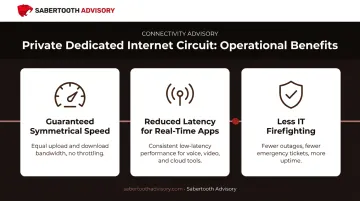
That private circuit delivers three operational benefits:
- Guaranteed symmetrical speed at any hour, including peak business hours when shared connections tend to slow down
- Reduced latency for real-time applications like VoIP, video conferencing, and cloud-hosted POS systems
- Less firefighting for IT teams, who stop chasing intermittent slowdowns that shared networks can't fully explain
Speed and configuration scale from smaller offices to large multi-site enterprises, with tiers from 10 Mbps to Tbps depending on location and need.
Where Dedicated Internet Fits
This product shows up most often in operations where a slow connection has a direct dollar cost:
- Multi-location businesses coordinating operations across branches
- Healthcare practices handling protected health information (PHI)
- Financial and logistics firms running mission-critical SaaS platforms
- Manufacturing plants with cloud-connected equipment on the production floor
City Rent a Truck, a logistics and fleet rental company, is a clear example. It needed reliable connectivity for a new headquarters and a St. Louis expansion. After moving to AT&T Dedicated Internet, its president reported 3.5 years without downtime across branch locations.
Calls could also transfer between branches from any authorized device — something much harder to guarantee on a shared connection.
What Is AT&T Business Fiber?
Business Fiber is AT&T's shared, symmetrical fiber product built for small and single-site businesses.
Symmetrical upload speed matters more than people realize. Cloud backups, VoIP calls, and video meetings all depend on upload bandwidth, not just download speed. A connection that's fast one way and slow the other creates friction fast.
The appeal here is simplicity:
- Self-serve online ordering with no sales call required
- Month-to-month terms with no multi-year lock-in
- Public pricing you can budget against without a custom quote
Tiers run from 300 Mbps up to 5 Gbps. The best value usually sits in the middle of the lineup, not the top, since most single-site businesses never fully use a 5 Gbps connection.
Where Business Fiber Fits
Business Fiber is the practical default for:
- Single-location law firms and professional services offices
- Medical admin suites that don't handle high-volume clinical data transfer
- Retail storefronts and small warehouses running everyday operations
The AT&T Business wireless bundle discount changes the math. A 1 GIG plan drops from $140 to $90 per month with an eligible wireless plan, and the 2 GIG and 5 GIG tiers each save $50 monthly. AT&T frames maximum first-year savings at $600—enough to matter when you compare total cost, not just sticker price.
AT&T Dedicated Internet vs Business Fiber: Which One Should You Choose in 2026?
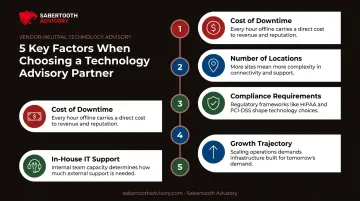
Five factors should drive this decision, and speed tier isn't one of them:
- Cost of downtime — What does an hour offline actually cost your business in lost sales, missed calls, or SLA penalties?
- Number of locations — Single-site operations have different needs than multi-branch ones
- Compliance requirements — HIPAA and PCI-DSS obligations often push businesses toward more controlled network environments
- Growth trajectory — Are you scaling headcount, locations, or data volume over the next 12 to 24 months?
- In-house IT support — Do you have staff who can troubleshoot shared-network issues, or do you need a provider that handles it proactively?
Choose Business Fiber if you're single-site, cost-sensitive, and can tolerate occasional shared-network variability during peak hours.
Choose Dedicated Internet if uptime is contractually non-negotiable, you operate across multiple sites, or your workloads involve large, continuous data transfer.
Many businesses start on Business Fiber and outgrow it. Watch for these signals:
- Recurring slowdowns during specific peak hours, not just occasional blips
- Clients or partners requiring a documented SLA you can't provide
- Expansion into a second or third location
Those signals matter in practice. The ACE Group, a customs broker and bonded-warehouse operator, shows what is at stake when connectivity fails. When a connectivity conduit failed and the business lost network redundancy, AT&T replaced the conduit and deployed Dedicated Internet alongside a hosted phone system. The result: more than 96.6% operational accuracy in day-to-day operations, a meaningful number for a business where shipment accuracy has direct compliance implications.
Because AT&T's Dedicated Internet pricing is quote-led and contracts often run multiple years, it pays to benchmark before signing.
Sabertooth Advisory reviews the quote against comparable offers from its 300+ supplier network and normalizes pricing to a 3-year total cost of ownership. It also checks SLA language for gaps carriers often leave vague, including weak mean-time-to-repair commitments or missing chronic-failure credits.
Want a second opinion on your AT&T quote before you sign? Request a free, vendor-neutral comparison and see how it stacks up against the broader market.
Conclusion
Neither product wins outright — the right pick depends on how costly downtime is for your operation. Business Fiber wins on simplicity and cost for single-site SMBs that don't need a formal uptime guarantee. Dedicated Internet wins on guaranteed performance when outages are genuinely expensive.
Base the decision on business outcomes, not brochure specs:
- Avoided downtime cost versus monthly circuit price
- Smoother scaling as you add locations
- Stronger compliance posture for frameworks like HIPAA and PCI-DSS
Get independent guidance before you sign either agreement. A vendor-neutral review — not a carrier sales conversation alone — helps match the circuit to your real risk profile and budget.
Frequently Asked Questions
Is AT&T business internet cheaper than personal internet?
Not typically. Business plans often cost more because they add SLAs, static IPs, and business-grade support, though bundling with AT&T Business wireless can lower the monthly cost.
What is the difference between Business Fiber and Dedicated Internet?
Business Fiber is a shared connection with performance that can vary during peak load. Dedicated Internet is a private, unshared circuit that guarantees consistent speed at all times.
Why would an AT&T fiber customer want a dedicated line?
Recurring peak-hour slowdowns, multi-site expansion, compliance requirements, or client-mandated SLAs are the most common triggers. Shared fiber simply can't guarantee the consistency some workloads need.
How much does AT&T Dedicated Internet cost in 2026?
Pricing is quote-based and varies by location, speed tier, and contract length. Request a current quote rather than relying on published figures, which AT&T doesn't display publicly for this product.
Does AT&T Dedicated Internet require a long-term contract?
Yes, it typically involves a multi-year agreement, unlike Business Fiber's no-contract model. That makes comparison shopping before you sign important.
Can a business upgrade from AT&T Business Fiber to Dedicated Internet later?
Yes. Businesses commonly start on Business Fiber and migrate to Dedicated Internet as uptime needs or compliance demands grow, though switching requires a new quote and installation timeline.