That scarcity shows up directly on invoices. Data center pricing has no single sticker price. Colocation, cloud, and build-your-own paths each carry different cost structures, and the final number depends heavily on power draw, location, contract terms, and service level.
This guide breaks down real pricing ranges, the cost components providers don't always highlight upfront, and how to budget accurately before you sign anything.
TL;DR
- Colocation: $50–$300/U/month for light loads; wholesale averages ~$196/kW/month at 250–500 kW
- Build your own: $9.5M–$13.3M per MW of IT capacity (before land, permitting, and ops)
- Power density, location, and contract length swing pricing more than almost any other factor
- GPU/AI racks and Tier IV cost far more—most standard workloads don’t need that redundancy
- Benchmark multiple providers before you sign—first quotes rarely win
How Much Does a Data Center Cost? (Pricing Overview)
Data center cost depends on the model you choose: colocation, a private build, or cloud infrastructure. Within colocation alone, power draw, location, and contract terms create wide swings in price.
Three mistakes drive most budget surprises:
- Underestimating power and amperage needs, then having to renegotiate or overpay for capacity never used
- Ignoring hidden fees like cross-connects, remote hands, and bandwidth overages that aren't in the base quote
- Comparing quotes that aren't apples-to-apples : one provider's "included" power is another's line-item add-on
Typical Cost Ranges
| Load Profile | Published Benchmark | What's Included |
|---|---|---|
| Entry-level / lightly loaded | $50-$300 per rack unit/month | Space, base power, shared network options |
| Mid-range / moderate cabinet | Custom-quoted | Higher amperage, enterprise redundancy, moderate network |
| Large wholesale (250-500 kW) | $196.25/kW/month average, up 6.6% year-over-year | High-density power, dedicated suites, premium SLAs |
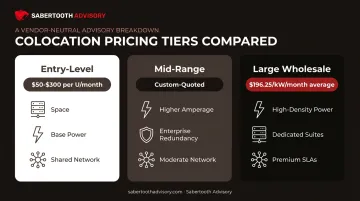
These figures typically cover physical space, critical-environment equipment, and shared facility upkeep. They usually exclude network circuits, cross-connect fees, and remote-hands support, according to phoenixNAP's 2025 colocation pricing guide.
Here is how those ranges map to real buyer profiles.
Entry-Level Colocation
Basic power tier, shared network options, and standard rack or half-cabinet space. Startups, light workloads, and backup or DR use cases with modest uptime needs usually land here.
Mid-Range Cabinets
Higher amperage circuits, enterprise redundancy, and moderate network capacity with room to scale. This is the common fit for growing SMBs with steady infrastructure demand and no extreme density requirements.
High-End and Wholesale
High-density power for GPU and AI workloads, dedicated suites, premium SLAs, and optional managed services. Enterprises, AI-heavy deployments, and regulated industries — including healthcare teams handling HIPAA-covered data — buy at this tier.
Key Factors That Affect the Cost of a Data Center
Pricing depends on technical specs, location economics, and the service model you choose. Here's what moves the needle most.
Facility Tier & Redundancy
Tier III facilities are concurrently maintainable — you can service one component without downtime, but a hardware failure can still cause an outage. Tier IV goes further: independent, physically isolated systems mean a single failure won't take you offline, according to Uptime Institute's Tier standards.
That extra resilience costs more, but there's no universal markup percentage. The premium reflects the actual redundant infrastructure built into the facility, not a fixed multiplier.
Location & Power Availability
Power-constrained markets are getting more expensive, fast. Key 2024–2025 market signals:
- Northern Virginia: 0.5% vacancy, only 21.5 MW available, large-deployment asking rates at $155–$185 per kW
- Silicon Valley: Pricing for 10 MW-plus requirements jumped 19% in H1 2025, driven by power constraints and AI demand
- US land costs: Weighted-average $5.59 per square foot ($244,000/acre) in 2024; 50+ acre parcels up 23% year-over-year
That scarcity is why developers are shifting into emerging markets — places like Tulsa, with lower energy costs, affordable land, and business-friendly incentives.
Rack Density & Power Draw
Most racks still run 4-6 kW, though average density (including outliers) calculates closer to 7-8 kW. Some facilities are pushing past 100 kW per rack as GPU-dense AI workloads accelerate demand, per Uptime Institute's 2024 Global Data Center Survey.
Amperage matters just as much as raw kW figures:
- Circuit size (15A, 20A, 30A) directly scales your monthly bill
- Overestimating power needs is one of the most common budget-busters in colocation contracts
- Voltage, single- vs. three-phase service, and A/B redundancy all affect what you actually pay for committed vs. metered power
Contract Length & Commitment Level
Longer commitments typically lower per-unit rates, but they reduce flexibility to renegotiate or exit if needs change. There's no standardized discount for a 3–5 year term versus month-to-month — every provider negotiates differently, so benchmarking is essential for a fair rate.
Network & Connectivity Requirements
Bandwidth is commonly billed at the monthly 95th percentile — providers measure usage in five-minute samples and drop the highest 5% of readings before calculating your bill. Other line items add variability:
- Cross-connect fees (installation and recurring)
- Carrier diversity and circuit costs
- Transit commitments
Get separate quotes for each before comparing providers.
Managed Services vs. Self-Managed
Outsourcing monitoring, rack-and-stack, and remote hands adds a premium to your monthly bill. In exchange, you offload work from internal IT — a trade-off that fits lean teams but is often unnecessary if you already have in-house capacity.
Cost Breakdown of Data Center Colocation
The quoted "base rate" is rarely your full bill. Here's what actually shows up across a colocation contract:
| Cost Component | Timing | Description |
|---|---|---|
| Space & power (base rent) | Recurring | Monthly fee tied to cabinet size and power draw |
| Setup & installation | One-time | Rack-and-stack, cabling, initial provisioning — typically $500-$3,000 depending on scope |
| Network & cross-connects | Recurring | Bandwidth circuits plus per-connection cross-connect fees |
| Remote hands / managed services | Recurring (usage-based) | Hourly or subscription fees for on-site support |
| Contract renewals & escalations | Periodic | Rate increases at renewal, often tied to market conditions |
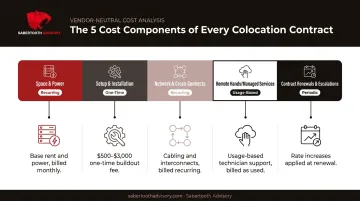
Facility operations are often rolled into the base rate, but confirm what the SLA actually covers before you assume anything is included. Power overages, cross-connect lead times, and remote-hands minimums are the line items that most often surprise first-time colo buyers.
Colocation vs. Building Your Own Data Center
Most businesses weigh these two paths before committing capital. Here's how they stack up.
Upfront Cost & Time to Deploy
- Colocation: Lower upfront cost, deployable in weeks once contracts are signed
- Build-your-own: High capital outlay, plus long permitting and construction timelines. In some markets, grid capacity is booked through 2030
Scalability & Flexibility
- Colocation: Easy to scale cabinets up or down as workload needs shift
- Build-your-own: Scaling requires new capital projects, not just a contract amendment
Total Cost of Ownership
- Colocation: Predictable recurring costs; the provider absorbs infrastructure risk
- Build-your-own: Owner bears full maintenance, upgrade, and compliance costs long-term
Operating an owned data center typically runs 2-5 times the cost of leasing colocation space, according to Data Center Dynamics. For most SMBs and mid-market companies, that math alone rules out a private build.
Private construction also carries steep per-MW costs. Turner & Townsend's 2025 index puts traditional air-cooled builds at $9.5M-$13.3M per MW across major US markets, with liquid-cooled AI facilities running 7-10% higher.
How to Avoid Overpaying: Budgeting Tips and Common Mistakes
Most overspending comes from poor scoping, not weak negotiating. Get the requirements right first, and the negotiation gets easier.
Budgeting tips that curb overspend:
- Scope power, space, and cooling to real load plus modest headroom—not peak-case fantasy
- Build a 3-year TCO that includes cross-connects, bandwidth, remote hands, and escalators
- Benchmark every quote against at least two other providers on the same requirements
- Set renewal reminders 6–12 months out so you negotiate before auto-renewal pressure hits
Common mistakes to avoid:
- Over-provisioning power and amperage, then paying monthly for capacity you never use
- Focusing only on the base rate while ignoring cross-connect, network, and remote-hands fees
- Accepting the first quote without a side-by-side comparison
- Underestimating renewal-period rate hikes and auto-renewal clauses that lock you in
Colocation pricing is opaque by design. Providers rarely structure quotes the same way, so side-by-side comparison is difficult without a standard process.
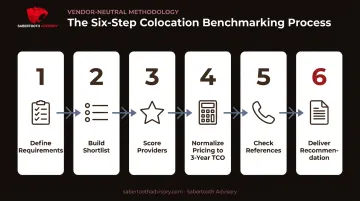
An independent, vendor-neutral advisor helps close that gap. Sabertooth Advisory benchmarks quotes across a 300+ supplier ecosystem with a six-step process:
- Define requirements
- Build a shortlist
- Score providers on identical criteria
- Normalize pricing to a 3-year total cost of ownership
- Check references
- Deliver a defensible recommendation
The same engagement can also right-size capacity, negotiate escalators and exit terms line by line, track renewals early, and audit invoices for silent charges—at $0 advisory fee to the client, because the model is supplier-funded.
Frequently Asked Questions
How much does a data center cost?
Costs range from a few hundred dollars per month for a light colocation rack to tens of thousands for high-density or dedicated suites. The final number depends on power draw, location, and service level.
How much does it cost to build a data center?
Building a private facility runs roughly $9.5M-$13.3M per MW of IT capacity before land, permitting, and operations. This makes private builds viable mainly for large enterprises, not SMBs.
What is the average cost per rack in a colocation data center?
Lightly loaded space typically runs $50–$300 per U per month, so full-rack cost scales with how many units and how much power you use. Moderate and high-density cabinets usually need custom quotes based on power draw and redundancy.
Is colocation cheaper than building your own data center?
Almost always, yes. Operating an owned facility typically costs 2-5 times more than leasing colocation space, making colocation the more cost-effective path for SMBs and mid-market companies.
What hidden fees should I watch for in data center contracts?
Watch for cross-connect fees, remote-hands charges, bandwidth overages billed above the 95th percentile, and renewal-period rate hikes tied to auto-renewal clauses.
How can I negotiate better data center pricing?
Benchmark multiple providers, understand your true power needs before quoting, and negotiate escalators and exit terms upfront. An independent advisor running a structured RFP typically secures better rates than negotiating solo.