
Here's the problem: there's no sticker price for DR. Cost depends on how fast you need to recover, whether you build in-house or buy it as a service, how big your environment is, and what compliance rules apply.
This guide breaks down real pricing ranges by tier and organization size, the factors that move the number most, and how to build a DR budget you can actually defend to your CFO — without overpaying for capabilities you don't need.
Key Takeaways
- Recovery objectives (RTO/RPO) and delivery model drive DR cost more than almost any other factor
- Basic backup-and-restore tiers cost far less than warm or hot standby environments
- In-house DR requires upfront capital; managed DRaaS shifts cost into predictable subscriptions
- Regulated industries (healthcare, finance) pay more for audit-ready recovery processes
- Vendor-neutral benchmarking is a fast way to avoid overpaying for DR
How Much Does a Disaster Recovery Plan Cost? (Pricing Overview)
DR pricing scales with three things: how much infrastructure you're protecting, how fast you need it back online, and whether you're building the solution yourself or paying a provider to run it.
There's no fixed number because those three variables move independently. A five-server business with a 24-hour recovery tolerance pays a fraction of what a hospital network with near-zero downtime requirements pays.
Common budgeting mistakes that inflate real costs:
- Underestimating hidden operational costs (testing, staffing hours, egress fees)
- Choosing a warm or hot standby tier for workloads that could tolerate a slower recovery
- Building DR in-house without budgeting for ongoing maintenance and patching
Typical Cost Range
Public cloud providers price DR by the unit — per server, per protected instance, per gigabyte — rather than publishing flat annual packages. Use those published rates as a baseline when modeling total spend:
- Small business (SMB): $5,000–$50,000 annually for a basic-to-moderate setup covering a modest server count (mostly infrastructure and subscription fees)
- Mid-market: $75,000–$400,000 annually when protecting hundreds of workloads with tighter recovery windows
- Large enterprise: High six figures to low millions annually at scale
A Kyndryl-sponsored IDC study of large enterprises (averaging 56,697 employees and $30.37B in annual revenue) found DRaaS investment of $2.83 million over three years, or roughly $944,000 per year.
These figures typically cover core infrastructure and subscription costs. They usually exclude failover testing, internal staffing time, and compliance-driven add-ons—the line items that most often push budgets past estimates.
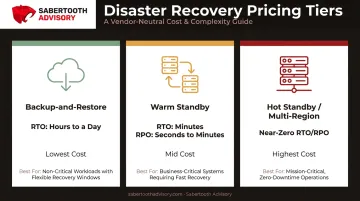
Price Range 1: Backup-and-Restore / Basic Tier
This is the entry-level tier most SMBs start with.
What's included:
- Offsite data backups with an RTO measured in hours to a full day
- Minimal standby compute — infrastructure is provisioned only when disaster strikes
- Lower ongoing cost since nothing runs continuously in the background
Best for: Non-critical workloads, internal tools, and archival data where a day of downtime is annoying, not catastrophic.
Price Range 2: Warm Standby / Standard DRaaS Tier
A scaled-down but functional copy of your environment runs in a secondary location and scales up on failover.
What's included:
- RPO measured in seconds to minutes
- RTO in minutes rather than hours
- Continuous replication and periodic failover testing
Best for: Mid-market businesses with moderate downtime tolerance: retailers, professional services firms, or logistics companies that can't afford a full-day outage but don't need zero downtime.
Price Range 3: Hot Standby / Multi-Region Enterprise Tier
Fully redundant infrastructure runs live across multiple regions, ready to take over traffic instantly.
What's included:
- Near-zero RPO and potentially zero RTO
- Active-active architecture serving production traffic from more than one location simultaneously
- Highest ops burden and cost of any DR strategy
Best for: Revenue-critical, customer-facing, or regulated systems where even a few minutes of downtime carries a real financial or compliance cost.
Key Factors That Affect the Cost of a Disaster Recovery Plan
DR cost isn't just a function of infrastructure size. It's shaped by technical requirements, risk tolerance, and how well you navigate vendor pricing models.
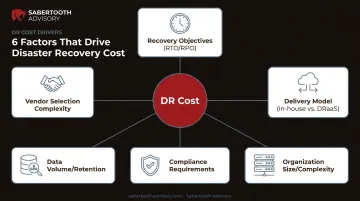
Recovery Objectives (RTO and RPO)
Tighter recovery time and recovery point objectives require infrastructure that's already running, not infrastructure you spin up after the fact. AWS's own reliability guidance ranks strategies from backup-and-restore (hours-long RTO) through pilot light and warm standby to multi-site active-active, noting that each step up demands more continuously running resources.
No provider publishes a clean "near-zero RTO adds X%" figure, but the pattern is consistent: the closer you get to zero downtime, the more you pay for capacity that sits idle most of the time.
Delivery Model: In-House vs. Managed (DRaaS) vs. Hybrid
Building DR yourself means capital outlay for hardware, software licenses, and a secondary site. Managed DRaaS converts that into a predictable monthly or annual subscription. Hybrid approaches (owning some infrastructure while outsourcing failover orchestration) split the difference. This is usually the single biggest lever on your total DR bill, and we'll break it down fully in the next section.
Organization Size and IT Environment Complexity
More servers, more locations, more applications: nearly every pricing model multiplies with each one. A DR plan for 20 workloads across one site looks nothing like one for 2,000 workloads spread across five regions, even at the same RTO/RPO tier.
Compliance and Regulatory Requirements
Regulated industries pay a premium for stricter controls. HIPAA requires covered entities to maintain a documented data backup plan, a disaster recovery plan, and an emergency-mode operations plan to protect electronic health information during a disruption.
Finance organizations face similar obligations under PCI-DSS for cardholder data environments. Neither regulation publishes a standard cost markup, but audit-ready documentation, tested failover procedures, and vendor due diligence all add real line items.
Data Volume, Retention Period, and Network/Egress Requirements
Storage tiering matters more than most budgets account for:
- Hot/frequently accessed storage costs more per gigabyte but has no retrieval fees
- Cold or archive storage costs less to store but carries early-deletion penalties if you don't meet minimum retention windows (often 90 to 365 days)
- Egress and data transfer fees apply when you pull data out during a real recovery or a test
Longer retention periods and larger data volumes compound all three.
Vendor and Technology Selection Complexity
The DRaaS market includes dozens of providers pricing by the server-hour, the protected instance, or the gigabyte stored, and rarely in directly comparable units. One vendor's per-VM model might look cheaper on paper than a competitor's flat-fee package, until you factor in egress charges, test-failover costs, and support tiers.
Comparing quotes apples-to-apples without a market benchmark is genuinely difficult. This is where firms like Sabertooth Advisory, working across 300+ vetted technology suppliers, help organizations benchmark DR/DRaaS quotes competitively through their Cloud & Colocation Advisory practice, rather than accepting a single vendor's pricing at face value.
In-House vs. Managed DR (DRaaS) — Cost Comparison
The biggest cost decision most organizations face isn't which RTO/RPO tier to buy. It's whether to build DR in-house or purchase it as a managed service.
| Factor | In-House DR | Managed DRaaS |
|---|---|---|
| Upfront investment | Capital spend on secondary site, hardware, and licensing | Little to no capital outlay; onboarding fees may apply |
| Ongoing cost | Variable: power, colocation, maintenance contracts | Predictable subscription plus usage-based add-ons |
| Staffing | Requires in-house DR/infrastructure expertise | Provider handles orchestration and failover testing |
| Recovery speed | Depends entirely on internal readiness and testing discipline | Vendor SLAs typically guarantee tested recovery windows |
| Scalability | Requires new capital cycles to expand | Scales with subscription tier changes |
Upfront/capital investment. In-house DR demands buying or leasing a secondary data center, hardware, and software licenses before you ever need them for an incident. Managed DRaaS largely converts that into operating expense: you pay for capacity you access on demand rather than capacity you own.
Ongoing operational cost. In-house environments carry variable costs: power, cooling, colocation fees, and periodic hardware refreshes. DRaaS providers bundle most of this into a subscription, though storage tier, retention length, and egress still show up as line items on your invoice.
Staffing and expertise required. Running DR in-house means someone on your team owns failover testing, patching, and incident response around the clock. DRaaS providers absorb most of that operational burden.
The IDC/Kyndryl study found managed DRaaS clients saw 24% greater business-continuity team efficiency and modeled IT-staff savings worth $4.36 million per organization per year. That figure reflects very large enterprises, not SMB-scale operations.
Recovery speed and reliability. DRaaS providers typically test failover more rigorously and consistently than internal teams juggling other priorities. The same Kyndryl study found RPO improved by 43% and RTO by 39% after moving to managed DRaaS. That is a meaningful signal, even accounting for the enterprise-only sample.
Long-term scalability and predictability. In-house DR requires new capital cycles every time you outgrow your current setup. DRaaS scales by adjusting your subscription tier, making multi-year budget forecasting more predictable.
How to Estimate the Right Budget for Your Disaster Recovery Plan
Before asking "what does DR cost," ask "what does my business actually need." That single reframe prevents most DR overspending.
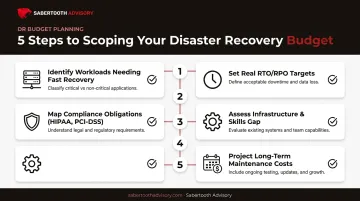
Factors to work through first:
- Which workloads truly need fast recovery — not everything deserves a hot standby tier
- Real RTO/RPO targets based on what an hour of downtime costs your business
- Retention and compliance obligations for your industry (HIPAA, PCI-DSS, and similar rules)
- Existing infrastructure and in-house skill, and whether a capability gap points toward DRaaS
- Long-term maintenance costs, not only the initial contract price
Common mistakes to avoid:
- Judging DR on the upfront quote instead of three-to-five-year total cost
- Overlooking recurring costs such as egress fees, testing hours, and storage tier upgrades
- Over-specifying recovery speed for systems that can tolerate a slower restore
- Accepting a single vendor quote without a competitive benchmark
For healthcare organizations, HIPAA contingency-plan rules set a compliance floor that shapes minimum RTO/RPO thresholds. Vendors should carry SOC 2 Type II certification as auditable proof their uptime commitments hold up.
Finance and payment-processing teams face the same pressure under PCI-DSS.
Those compliance floors only help if you can compare providers on equal terms. DR and DRaaS pricing models differ widely, so teams without a dedicated procurement function often benefit from an independent advisor who can run a structured RFP and benchmark suppliers side by side.
Sabertooth Advisory's vendor-neutral model is funded by suppliers, not client fees. That structure helps organizations negotiate DR contracts from a position of strength instead of taking the first number a provider offers.
Conclusion
Disaster recovery cost swings widely based on three things: how fast you need to recover, whether you build or buy, and how complex your environment is. There's no universal price tag. Anyone quoting one without asking about your RTO/RPO targets is guessing.
Understanding these cost components turns DR budgeting from a shot in the dark into a decision you can defend in a budget meeting. Match your DR spend to what downtime would actually cost your business. That figure, not the cheapest quote or the longest feature list, is what makes a plan worth funding.
Frequently Asked Questions
How much does a disaster recovery plan cost?
Costs range from a few thousand dollars a year for small businesses using basic backup-and-restore tiers to well into six or seven figures annually for large enterprises. Delivery model and recovery objectives are the biggest cost drivers.
When would a disaster recovery plan be activated?
A DR plan activates during any event that disrupts normal IT operations: cyberattacks, hardware failure, natural disasters, or major outages. Activation happens once predefined triggers or thresholds in the plan are met.
What does a disaster recovery plan cover?
It covers critical data, applications, and infrastructure with defined RTO/RPO targets. Plans also include recovery procedures, assigned roles, and a regular testing schedule.
Is DRaaS more expensive than backup?
Yes, generally. DRaaS maintains standby compute and orchestration for fast failover, while plain backup is priced mainly on storage volume with no failover infrastructure included.
How can I reduce disaster recovery costs?
Three practical levers cut spend without weakening recovery:
- Tier workloads by actual criticality
- Right-size RTO/RPO instead of defaulting to the fastest option
- Benchmark multiple vendor quotes before you buy
Is a disaster recovery plan worth the cost for a small business?
Almost always. Downtime costs can exceed $300,000 per hour for the majority of surveyed firms, according to ITIC's 2024 research — a figure that dwarfs the annual cost of a right-sized DR plan for most small businesses.