This isn't a minor procurement detail. The choice shapes your upfront capital outlay, how fast you can deploy, how much control you retain over infrastructure, and your total cost of occupancy across a lease term that can run 10 to 20 years.
The scale of investment underway makes this decision even more consequential. McKinsey projects that worldwide data center infrastructure will require $6.7 trillion by 2030, with $5.2 trillion tied directly to AI-processing demand.
This guide breaks down what each model actually delivers, where each one fits, and how to match the decision to your company's technical maturity and growth trajectory.
Key Takeaways
- Turnkey facilities are fully built and operator-managed, priced per kW, and ready for near-immediate occupancy
- Powered Shell provides building, power, and connectivity only—tenants fit out the interior at lower per-square-foot rates
- Pick turnkey if you lack dedicated data center staff and need speed plus cost predictability
- Pick powered shell for custom AI or high-density builds when you have in-house engineering depth
- Capital, engineering resources, and lease-length preferences decide which model fits
Powered Shell vs Turnkey: Quick Comparison
Here's how the two models compare on the factors that drive most leasing decisions.
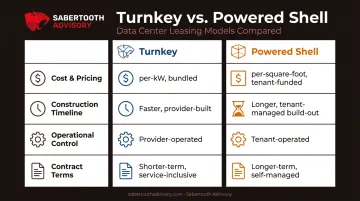
| Factor | Turnkey | Powered Shell |
|---|---|---|
| Pricing basis | Per kW of critical IT load | Per square foot |
| Upfront tenant capex | Low | High (tenant funds fit-out) |
| Deployment timeline | 12–24+ months, but ready on handover | Shell in 6–12 months, plus 3–6 months of tenant fit-out |
| Customization | Limited; operator controls design | High; tenant designs cooling, power, layout |
| Typical lease term | 5–10 years | 10–20+ years, often triple-net |
| Best fit | Enterprises, colocation users | Hyperscalers, AI/cloud operators |
Cost and pricing. Turnkey carries a higher monthly rate because finished infrastructure, cooling, and operator management are built into the price. Powered Shell flips that structure: the headline lease rate is lower, but you fund UPS systems, generators, and cooling yourself.
Construction timeline. Turnkey takes longer from groundbreaking because the operator finishes the entire interior before handover. A powered shell is ready faster, but tenants still need several months to install their own systems before going live.
Operational control. Turnkey operators set cooling type, power redundancy, and maintenance schedules, which limits flexibility. Powered Shell puts those choices in your hands, which is especially important for GPU-dense AI racks that need non-standard cooling.
Contracts and tenant fit. Turnkey leases tend to run shorter and suit multi-tenant colocation users. Powered Shell leases run longer, often as triple-net agreements built around a single large tenant's roadmap.
What Is a Turnkey Data Center?
A turnkey data center is a fully constructed, fully equipped facility ready for immediate occupancy. The operator has already installed power distribution, cooling, fire suppression, and physical security. You show up, plug in your racks, and start operating.
That matters most for companies without a dedicated data center engineering team. Instead of hiring facility specialists or managing mechanical systems, you lease finished capacity and let the operator handle the technical heavy lifting.
Core benefits include:
- Fast time to operational readiness, since the interior is already complete
- Predictable all-in operating costs bundled into a single per-kW rate
- Vendor-managed maintenance that reduces downtime risk
- Simplified IT operations for teams focused on applications, not facilities
Turnkey facilities typically run as single-tenant or multi-tenant colocation environments. Specialist data center operators almost always build them, not the end user.
Use Cases of Turnkey Data Centers
Turnkey fits organizations that need compliant, managed infrastructure without in-house facility engineers—banks, healthcare systems, and mid-market enterprises under strict uptime SLAs. Compliance certifications, physical security, and SLA-backed uptime come baked into the facility, which removes operational risk those teams would otherwise own.
Pricing context: CBRE's H2 2025 North America Data Center Trends report puts the average asking rate for 250–500 kW requirements in primary wholesale-colocation markets at $196.25 per kW per month, up 6.6% year over year. Turnkey deals are built around that per-kW pricing language.
What Is a Powered Shell Data Center?
A powered shell is a partially completed facility. You get the building envelope, site power delivered to the property line, and connectivity options such as fiber proximity. What you don't get: UPS systems, generators, cooling infrastructure, or finished IT space. That's on you.
This model matters most for tenants with unique technical requirements, especially AI workloads running dense GPU clusters that standard turnkey cooling wasn't designed to handle.
Core benefits include:
- Full design control over cooling, power redundancy, and floor layout
- Faster speed-to-market for large deployments—no waiting on generic build-outs
- Lower per-square-foot lease rates compared to fully finished space
- Infrastructure built for high-density compute, not a generic spec
Powered shell projects vary widely in how they’re delivered:
- Ground-up construction built around tenant specifications
- Phased builds that expand as demand grows
- Retrofitted industrial buildings converted into shell space
Use Cases of Powered Shell Data Centers
Hyperscale cloud providers and AI companies are the primary users of powered shell space. They need custom power and cooling architecture at multi-hundred-megawatt scale. Large colocation operators and telecom providers running campus-style deployments follow a similar approach.
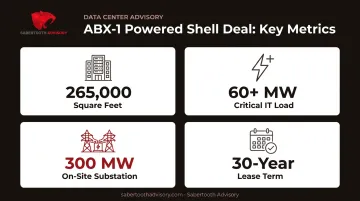
A documented example: PowerHouse Data Centers leased its entire 265,000-square-foot, 60+ MW ABX-1 powered shell in Ashburn, Virginia to CyrusOne on a 30-year lease, backed by an on-site 300 MW substation. That 30-year commitment reflects what powered shell tenants accept when full infrastructure control is non-negotiable.
Powered Shell vs Turnkey: Which Model Is Right for Your Business?
Four factors should drive this decision:
- Available capital — Can you fund interior fit-out, or do you need infrastructure costs bundled into rent?
- In-house technical resources — Do you have staff who can design and manage power and cooling systems?
- Urgency of deployment — Do you need to be operational in months, or can you absorb a longer build timeline for better long-term fit?
- Workload type — Is this standard enterprise IT, or AI/high-density compute that needs custom cooling?
Choose Turnkey if your organization lacks dedicated data center operations staff and prioritizes predictable costs with fast, hands-off deployment.
Choose Powered Shell if you have engineering resources, anticipate scaling AI or high-density workloads, and want long-term control over infrastructure design and cost trajectory.
Most mid-market organizations lack the internal bandwidth to benchmark facility operators objectively. Independent guidance fills that gap.
Sabertooth Advisory matches power, rack space, cross-connects, and commercial terms to your actual workloads, then benchmarks those needs across 300+ vetted providers before any lease is signed.
Real-World Example: Choosing Between the Two Models
The CyrusOne/ABX-1 deal illustrates the tradeoff clearly. CyrusOne needed substantial power in a market where land and interconnection are scarce.
It also needed freedom to build interior infrastructure to its own standards instead of accepting a generic turnkey spec. The trigger was capacity: a 300 MW substation delivering more than 60 MW to one building. Speed to secure the site mattered as much as long-term design control.
CyrusOne signed a 30-year lease, choosing decades of infrastructure control over the faster occupancy a turnkey facility might have offered.
The takeaway: neither model is universally "better." The right choice depends on internal capability and workload profile, not a fixed formula.
If you are weighing a similar decision, an independent advisor can run a competitive RFP across qualified colocation and powered-shell providers, negotiate pricing and SLAs, and document a defensible recommendation before you commit capital.
Schedule an advisory call or call +1 (888) 891-2331 to start that process.
Conclusion
Turnkey delivers speed and predictable costs when you lack in-house facility expertise. Powered Shell trades some of that convenience for control, customization, and stronger long-term cost efficiency—better suited to technically sophisticated, high-growth tenants with demanding workloads.
The right choice ties directly to business outcomes: deployment speed, total cost of occupancy, and your ability to scale for AI and compute growth. A structured, vendor-neutral evaluation—not a single operator's sales pitch—reduces the risk of locking into a facility that doesn't match how your business operates. Sabertooth Advisory helps SMB and mid-market teams run that comparison across a broad supplier ecosystem, with no brand quotas, so the model you pick fits your timeline, workload, and budget.
Frequently Asked Questions
What is the difference between a turnkey and a powered shell data center?
Turnkey facilities are fully built, operator-managed, and ready for immediate occupancy. Powered shell facilities supply the building, power, and connectivity — tenants build and run the interior systems.
What does "powered shell" mean in a data center?
A powered shell is the building envelope plus base site power and fiber connectivity. It excludes cooling, UPS systems, and generators, which tenants install.
What is a turnkey data center?
A turnkey data center is a fully constructed, equipped, and ready-to-operate facility. Operators typically lease this space on a per-kW basis rather than per square foot.
What are the four tiers of data centers?
Uptime Institute's Tier I–IV system classifies infrastructure redundancy and uptime guarantees, from Basic Capacity (Tier I) to Fault Tolerant (Tier IV). This is separate from the turnkey/powered shell delivery model.
How much does a powered shell data center cost compared to a turnkey facility?
Powered shell leases are quoted per square foot at a lower headline rate, but tenants add significant fit-out costs. Turnkey leases are quoted per kW, bundling infrastructure costs into a higher, all-in monthly rate.
Which model is better suited for AI and high-density computing workloads?
Powered shell fits AI and high-density workloads better because tenants can design custom cooling and power redundancy for GPU-dense racks instead of accepting a standard turnkey spec.