Introduction
Growing past a single location changes everything about how you think about your network. Add cloud apps, remote teams, and a handful of new branches, and suddenly your old network design starts creaking.
That's when the IP VPN vs SD-WAN question shows up — and it trips up a lot of IT leaders. Many assume SD-WAN is "just a fancier VPN." It isn't.
Get the choice wrong and you'll either overpay for bandwidth you don't need or end up with a network that can't keep pace with growth.
Site connectivity that was standard a decade ago (MPLS-heavy, provider-managed) is losing ground fast, dropping from 82% of enterprise sites in 2018 to 51% in 2022 as businesses move toward flexible, software-driven alternatives.
This article breaks down what actually separates IP VPN from SD-WAN, where each one fits, and how to figure out which one (or both) your business actually needs.
Key Takeaways
- IP VPN delivers private MPLS bandwidth with guaranteed SLAs, at higher cost and slower provisioning.
- SD-WAN routes traffic across multiple connection types for agility and centralized control.
- Regulated, latency-sensitive workloads favor IP VPN; distributed, cloud-first operations favor SD-WAN.
- Many mid-market networks layer SD-WAN on an MPLS underlay instead of choosing one exclusively.
- Side-by-side carrier and vendor comparisons before contract prevent overpaying for unused capacity.
IP VPN vs SD-WAN: Quick Comparison
Before the architecture deep-dive, here's how the two stack up on the factors that matter most.
| Factor | IP VPN | SD-WAN |
|---|---|---|
| Cost | Higher fixed costs from dedicated MPLS circuits | Lower entry cost using existing broadband/internet |
| Performance | Predictable, low-latency, uncontended bandwidth | Depends on underlying internet quality |
| Security | Private, isolated via VRF/MPLS segmentation | Encrypted tunnels plus added security stack needed |
| Scalability | Slower provisioning, carrier-dependent | Rapid deployment via software provisioning |
| Management | Provider-managed, limited visibility | Centralized dashboard, real-time control |
Cost
IP VPN's dedicated MPLS circuits and leased lines carry a higher price tag upfront. That said, centralized provider management can reduce long-term operating overhead since the carrier handles most of the heavy lifting.
SD-WAN flips this. It leans on connections you likely already have (broadband, LTE, fiber), which lowers entry cost significantly. The tradeoff is complexity: managing multiple transport types and security layers can add operational work your team wasn't budgeting for.
Performance and Provisioning
IP VPN wins on predictability. Guaranteed QoS over uncontended bandwidth means no surprises for latency-sensitive traffic. SD-WAN's dynamic path selection helps compensate for inconsistent internet quality, but it's still working with a less controlled foundation.
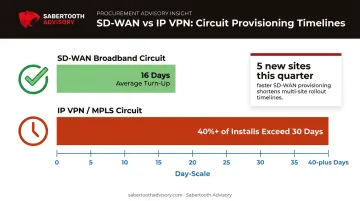
Provisioning tells a similar story. Nemertes research found average wired-internet circuit turn-up at 16 days, while more than 40% of organizations struggled to get a new MPLS link installed within a month. If you're opening five new sites this quarter, that gap matters.
Security and Flexibility
IP VPN's VRF/MPLS segmentation keeps traffic isolated from the public internet by design. SD-WAN relies on encrypted IPsec tunnels and typically needs firewalls or SASE layered in at each site to reach comparable protection.
SD-WAN's centralized, software-based provisioning lets IT teams spin up new or temporary locations fast. That flexibility matters for businesses that open, close, or relocate sites often.
What Is IP VPN?
IP VPN is a private network service delivered over a provider's MPLS backbone. Customer traffic gets isolated through VRF segmentation and MPLS labels, meaning your data never touches the open internet.
That isolation matters most when downtime isn't an option. Real-time systems like ERP platforms and VoIP need consistent jitter and latency, not "usually fine" performance.
Core benefits include:
- Guaranteed SLAs backed by the carrier
- Predictable jitter and latency across all connected sites
- Class of Service (CoS) support that prioritizes critical traffic
- Reduced downtime risk for legacy, on-premise systems
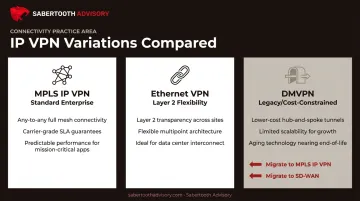
Common variations include:
- MPLS IP VPN — the standard enterprise form, delivered over the carrier MPLS backbone
- Ethernet VPN — similar isolation with Layer 2 flexibility between sites
- DMVPN — a legacy tunnel option still found in cost-constrained or older deployments
Most enterprises have moved from DMVPN to MPLS IP VPN or SD-WAN for better scalability and centralized management.
Where IP VPN Fits
IP VPN makes the most sense connecting data centers, headquarters, and branch offices where predictable, secure connectivity isn't negotiable. Think:
- Healthcare organizations moving HIPAA-regulated patient data between facilities
- Financial services firms running transaction systems that can't tolerate jitter
- Manufacturing sites operating legacy on-premise applications tied to deterministic performance
At Sabertooth Advisory, the connectivity practice still evaluates MPLS and Ethernet private circuits for this reason. Private, predictable, low-latency interconnects still justify their cost in specific environments, even as the broader market shifts toward software-defined alternatives.
What Is SD-WAN?
SD-WAN is a software-defined architecture that uses centralized policies to intelligently route traffic across multiple transport types simultaneously: MPLS, broadband, LTE, 5G, whatever's available. Instead of committing to one pipe, the network picks the best available path for each application in real time.
For cloud-first, distributed organizations, this matters a lot. Backhauling every SaaS request through a central data center adds latency nobody wants.
Core benefits include:
- Dynamic path selection that reroutes around congestion or outages
- Application-aware routing that prioritizes business-critical traffic
- Centralized visibility across every connected site
- Reduced IT management overhead for distributed footprints
Two deployment models are common. With DIY on-premise SD-WAN, your team manages the platform directly. With managed SD-WAN, a service provider handles day-to-day operations.
Many platforms now integrate with SASE frameworks as well, unifying networking and security under one policy layer.
Where SD-WAN Fits
SD-WAN shines wherever the site count is high and changes frequently:
- Retail chains connecting POS systems directly to cloud applications
- Franchise organizations onboarding new locations on tight timelines
- Trucking and logistics companies managing distributed terminals, warehouses, and dispatch hubs
AT&T's SD-WAN rollout across more than 6,000 U.S. retail sites took just five months, averaging 400 sites per week with over 95% first-time turn-up success. That deployment speed simply isn't realistic with traditional MPLS provisioning timelines.
Construction firms see a different but equally strong fit. Jobsite trailers move every few months, and there's often no fiber or fixed broadband on-site. SD-WAN policy managed over LTE/5G failover keeps field teams connected without re-engineering the network every time a project wraps.
IP VPN vs SD-WAN: Which Is Better for Your Business?
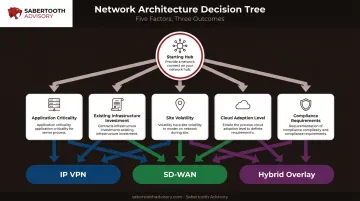
There's no universal winner here. The right answer depends on a handful of factors specific to your operation:
- Application criticality — Do you run real-time, latency-sensitive systems, or mostly cloud/SaaS traffic?
- Existing infrastructure investment — Are you already locked into MPLS contracts with time left on them?
- Site volatility — Are you opening and closing locations regularly, or is your footprint stable?
- Cloud adoption level — How much of your traffic is destined for SaaS or public cloud versus on-prem systems?
- Compliance requirements — Does your industry mandate strict data isolation (HIPAA, PCI-DSS)?
Choose IP VPN if your business runs latency-sensitive legacy applications, needs strict SLAs, or operates in a heavily regulated industry where deterministic performance isn't optional.
Choose SD-WAN if you're cloud-first, adding or closing sites often, or prioritizing cost flexibility and centralized visibility over guaranteed private bandwidth.
In practice, plenty of mid-market and enterprise organizations don't pick one. They run SD-WAN as an overlay on an existing MPLS/IP VPN underlay. That keeps guaranteed performance for critical traffic while adding SD-WAN agility everywhere else.
With 300+ carriers and SD-WAN providers offering different SLAs, pricing models, and coverage footprints, comparing options accurately on your own is hard. A vendor-neutral comparison helps you avoid overpaying or locking into architecture that doesn't match how you operate.
If you're weighing a multi-year IP VPN or SD-WAN contract, get a free network assessment from Sabertooth Advisory before you sign. It takes about five minutes to start and returns a prioritized, vendor-neutral roadmap—not a single carrier's pitch.
Conclusion
Neither IP VPN nor SD-WAN is inherently "better." The right call depends on how critical your applications are, how many sites you manage, how much you rely on the cloud, and what your budget looks like. Plenty of organizations land on a hybrid of both—and that is often the smartest outcome, not a compromise.
Whatever you decide, the outcome that matters is practical: less downtime, lower total cost of ownership, and a network that scales with your business instead of holding it back. Validating that choice against real market options—not just the first carrier that calls you back—is what separates a good network decision from a lucky one.
If you want a vendor-neutral read on IP VPN, SD-WAN, or a hybrid design, Sabertooth Advisory can benchmark options across 300+ suppliers and help you choose on fit, cost, and risk—with $0 advisory fees to you.
Frequently Asked Questions
Is SD-WAN just VPN?
No. SD-WAN is a broader traffic management architecture that often uses VPN (IPsec) tunnels internally. It adds centralized control, dynamic path selection, and performance optimization that a standalone VPN doesn't offer.
Is IP VPN the same as MPLS?
Not quite. MPLS is the underlying label-switching transport technology, while IP VPN is the private network service delivered on top of it. Think of MPLS as the road and IP VPN as the private lane running on it.
Is DMVPN still used?
Yes, in some legacy or cost-sensitive environments. Most enterprises, though, have shifted to MPLS IP VPN or SD-WAN for better scalability, security, and centralized management.
Can SD-WAN and IP VPN work together?
Absolutely. Many enterprises run SD-WAN as an overlay on top of an IP VPN/MPLS underlay, combining SD-WAN's flexibility with IP VPN's guaranteed performance for critical traffic.
Which is more secure, IP VPN or SD-WAN?
IP VPN has a smaller attack surface since it runs on private MPLS transport. SD-WAN needs additional security layers, like firewalls or SASE, because it often relies on internet-based links.
Is SD-WAN cheaper than IP VPN?
Often yes upfront, since it uses existing broadband connections. Total cost still depends on management overhead, security add-ons, and site count—run a side-by-side comparison before you decide.