That spread is exactly why pricing keeps showing up as a top blocker to migration decisions. A Flexera survey of more than 750 cloud decision-makers found that 84% consider managing cloud spend their single biggest challenge, with budgets already running 17% over limits before migration even factors in.
Cost depends on workload size, the migration strategy you pick, your cloud provider, and how much refactoring or compliance work is baked in. This guide breaks down realistic pricing ranges, the full cost breakdown most quotes leave out, and how to build a budget that actually holds up.
TL;DR
- Small migrations run in the tens of thousands; enterprise programs reach six or seven figures
- Migration strategy, data volume, and compliance scope drive costs more than server count alone
- Clean, well-documented environments cost less; regulated multi-app estates cost more
- Upfront spend on refactoring or expert guidance usually lowers your long-term cloud bill
How Much Does Cloud Migration Cost? (Pricing Overview)
There's no single price tag for cloud migration. Costs depend on how many workloads you're moving, which migration strategy you choose, and which provider you land on. You also need to budget for two separate things: the one-time project cost and the ongoing run cost once workloads are live.
Three things commonly blow up the budget when cost isn't fully understood:
- Underbudgeting the double-run period — running legacy and cloud environments in parallel gets expensive fast
- Choosing the wrong migration strategy — rehosting a workload that actually needed refactoring creates rework later
- Missing post-migration costs — optimization, governance, and rightsizing don't stop at cutover
McKinsey's research backs this up. In a survey of nearly 450 CIOs, the average company spent 14% more on migration than planned each year, and 38% saw migrations slip by more than a quarter. Across three years, McKinsey estimated more than $100 billion in wasted migration spending industry-wide.
Small Workload Migration
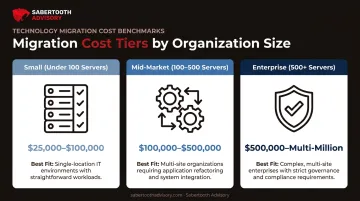
For estates under 100 servers with clean inventories and few dependencies, one-time project costs typically land in the $25,000–$100,000 range. This tier covers basic discovery, straightforward lift-and-shift, and limited testing — the fastest path for organizations without tangled application dependencies.
Mid-Market Migration
Between 100 and 500 servers, one-time project costs more often fall between $100,000 and $500,000. Budgets stretch to cover integration work, a longer hybrid overlap period, and partial refactoring for apps that don't lift cleanly. This tier fits growing businesses with moderate complexity and a few systems that need modernization.
Enterprise Cloud Migration
At 500+ servers across multi-wave programs, one-time project costs commonly start around $500,000 and run into the millions. Expect dedicated governance, compliance validation, and phased rollouts. AWS's case study with 3M shows the scale: 2,200 applications migrated across 51 waves over 24 months, ending in more than 6,200 EC2 instances. This tier suits large, multi-site, or regulated organizations with distributed ownership across business units.
| Tier | Server estate | Typical one-time project cost | Best fit |
|---|---|---|---|
| Small | Under 100 | $25,000–$100,000 | Clean inventories, few dependencies |
| Mid-market | 100–500 | $100,000–$500,000 | Moderate complexity, some refactoring |
| Enterprise | 500+ | $500,000–multi-million | Multi-wave, multi-site, regulated |
Across every tier, published ranges usually cover planning, execution, and data transfer only. They typically exclude long-term run costs, compliance validation, and deeper refactoring — exactly where budgets break down.
Key Factors That Affect the Cost of Cloud Migration
Cost isn't just about workload count. It comes down to technical choices, how workloads actually behave once you touch them, and how much organizational change the migration forces.
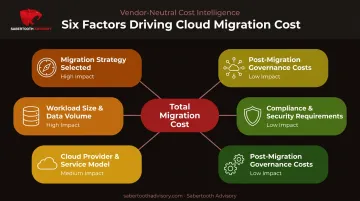
Migration Strategy Selected
Rehosting, or lift-and-shift, is almost always cheaper upfront than refactoring or re-architecting. AWS's own guidance covers seven migration strategies (retire, retain, rehost, relocate, repurchase, replatform, and refactor). It lists refactoring as the most complex and costly because it redesigns core components mid-migration.
The strategy you pick doesn't just affect the migration bill. It shapes your long-term run cost too. A rehosted workload can carry forward the same inefficiencies it had on-premises.
Workload Size, Data Volume, and Complexity
More servers, more applications, and more interdependencies mean more planning effort and more execution cost. Data transfer often becomes the surprise line item:
- Transfer service fees: Google's Storage Transfer Service charges roughly $0.0125 per GiB for agent-based file transfers
- Repeat syncs and rollbacks: A second sync cycle or rollback test doubles that service charge
- Egress fees: Source-cloud egress stacks on top before storage charges even apply
Cloud Provider and Service Model
IaaS, PaaS, and SaaS carry different cost structures. IaaS puts more management responsibility (and cost) on you; PaaS and SaaS shift more onto the provider but limit flexibility.
Provider pricing for compute, storage, and request fees also varies widely. Comparing providers without vendor bias helps avoid overpaying for capabilities a workload never uses.
Integration, Dependencies, and Landing Zone Setup
IAM configuration, network design, security policy setup, and undocumented dependencies between applications add engineering hours that almost never show up in early estimates. This is usually where "simple" migrations stop being simple.
Compliance and Security Requirements
Regulated industries — healthcare, finance — face added costs for encryption validation, audit trail setup, and control mapping against frameworks like HIPAA or PCI-DSS. These requirements don't disappear after cutover; they need continuous validation.
Post-Migration Operating and Governance Costs
Rightsizing, tagging, monitoring, and optimization work continues well past cutover, and it directly affects your ongoing cloud bill. Flexera's 2025 research found that organizations still waste an estimated 27% of their IaaS and PaaS cloud spend, even after migration is complete.
Cost Breakdown of Cloud Migration
Total migration cost goes beyond the number on your project quote. It includes one-time components and recurring ones that keep showing up long after cutover.
| Cost Component | Timing | What It Covers |
|---|---|---|
| Planning and discovery | One-time | Workload inventory, dependency mapping, strategy selection |
| Migration execution and data transfer | One-time | Data movement, tooling, testing, cutover |
| Interim double-run operation | Temporary, recurring | Legacy and cloud environments running in parallel, including duplicated licensing |
| Cloud run costs (post-cutover) | Recurring | Ongoing compute, storage, network, and managed service fees |
| Optimization, governance, and upgrades | Periodic | Rightsizing reviews, tagging cleanup, commitment purchases like Savings Plans or Reserved Instances |
The double-run row is where most budgets go sideways. There's no universal formula, but you can calculate it wave by wave:
- Legacy monthly run rate × overlap months
- Cloud monthly run rate × overlap months
- Synchronization and testing charges on top
Don't stop the legacy cost line until decommissioning is contractually and operationally finished, not just technically finished.
The optimization row matters more than it looks. McKinsey found that technology leaders can cut cloud-program costs by 15% to 25% without destroying value, largely through service fit review, removing unused assets, and storage tiering. Those savings stay on the table if optimization gets skipped after cutover.
Low-Cost vs High-Cost Cloud Migration Approaches — What's the Difference?
A fast rehost and a slower, deeper refactor sit at opposite ends of the cost spectrum. Neither one is universally "right."
| Factor | Lower-Cost Approach (Rehost) | Higher-Cost Approach (Refactor / Managed Migration) |
|---|---|---|
| Speed and upfront cost | Faster, minimal changes, lower initial spend | Longer timeline, deeper redesign, higher upfront investment |
| Long-term operating efficiency | May carry forward inefficiencies, higher steady-state run cost | Better use of cloud-native services, often lower long-term spend |
| Risk and compliance coverage | Higher risk of gaps in validation, security, and dependency mapping | More thorough testing, governance, and compliance alignment |
Neither column is automatically the better choice. A workload with a short shelf life doesn't need a refactor. A core system running for the next decade probably shouldn't be lifted and shifted as-is.
The right call depends on:
- Workload lifespan
- Business criticality
- How much technical debt you're willing to inherit
How to Estimate the Right Budget for Cloud Migration
The right budget balances upfront cost, workload fit, and long-term run rate. Chasing the lowest quote usually just moves the cost somewhere less visible.
Factors to weigh before setting a number:
- Number and complexity of workloads, including dependencies and data volume
- Expected length of the double-run or hybrid overlap period
- Industry-specific compliance and security requirements, such as HIPAA or PCI-DSS
- Whether internal teams have the skills to execute, or whether outside expertise is needed
Common budgeting mistakes to avoid:
- Focusing only on the upfront quote and ignoring recurring run costs
- Skipping post-migration optimization planning entirely
- Over-customizing workloads that didn't need refactoring
- Choosing a provider without comparing alternatives side by side
That last mistake is where independent review pays for itself. Sabertooth Advisory provides a vendor-neutral review of supplier quotes and contract terms across its 300+ supplier ecosystem, at no cost to the client.

That review typically covers:
- Benchmarking pricing against street rates (not list price)
- Structuring RFPs so suppliers respond to identical criteria
- Negotiating MRR escalators, SLA credits, and exit provisions before signature
For SMB and mid-market organizations without a dedicated procurement team, that review often catches gaps a single vendor quote won't flag.
Build the budget around the full cost breakdown—not the cheapest line item. The spend that holds up is the one that balances speed, risk, and long-term run rate.
Frequently Asked Questions
How much does a cloud migration cost?
Small workloads typically run in the tens of thousands of dollars, while enterprise programs can reach the high six figures or millions. Labor, data movement, and double-run overlap drive cost far more than raw compute pricing.
How much does 100 TB of cloud storage cost?
Storage cost depends on provider and tier. Azure Blob Hot LRS is about $1,805/month for 100 TB; Google Cloud Storage Standard in us-central1 is about $1,863/month—before requests, retrieval, or transfer fees.
What is the cheapest way to migrate to the cloud?
Rehosting, or lift-and-shift, is typically the lowest upfront-cost strategy since it requires minimal changes to the application. It can carry higher long-term run costs, though, if workloads aren't optimized after the move.
How long does a typical cloud migration take?
Timelines range from a few weeks for small, simple workloads to a year or more for enterprise programs. AWS recommends keeping individual migration waves within 6 to 10 weeks to maintain momentum on larger programs.
What hidden costs should businesses expect during migration?
The most commonly underestimated costs are double-run overlap, data egress fees, integration and dependency work, and compliance validation. None of these typically appear in an initial project quote.
Does cloud migration actually save money long term?
Savings usually show up after workloads stabilize and waste is removed—not at cutover. Infrastructure cost drops when governance and rightsizing are in place, not from the move alone.