
For SMB and mid-market IoT programs, this scale creates a real headache. Managing SIMs across regions, tracking usage against contracts, enforcing security policies, and reconciling billing from three or four carriers at once can eat up more staff time than the devices themselves.
This guide breaks down what an IoT connectivity platform actually does, ranks the top options for 2026, and gives you a framework for evaluating them against your own device volume, geography, and compliance needs — not just marketing claims.
TL;DR
- IoT connectivity platforms centralize SIM/eSIM provisioning, multi-carrier management, billing, and security for device fleets.
- Top 2026 platforms: Aeris, KORE Wireless, Cisco IoT Control Center, FloLIVE, Onomondo, and EMnify — strengths vary by coverage, control, and cost model.
- Prioritize global coverage, scalability, security depth, and total cost of ownership over headline data rates.
- A vendor-neutral advisor can help you compare options objectively and avoid long-term carrier lock-in.
Overview of IoT Connectivity Platforms in 2026
An IoT connectivity platform, sometimes called a connectivity management platform (CMP), is the software and network layer that handles the operational side of running a cellular-connected device fleet. That includes SIM and eSIM provisioning, switching between carrier networks, usage tracking, billing, and basic device diagnostics.
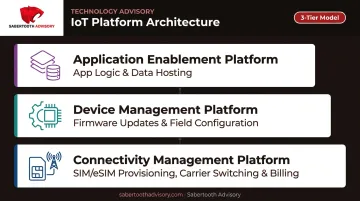
It's a distinct layer from device management platforms (which handle firmware and field-device configuration) and application enablement platforms (which host the actual app logic). Transforma Insights defines a CMP specifically as the tool that manages cellular activation, subscriptions, network administration, billing/rating, and increasingly eSIM profile changes.
These three layers get blurred together constantly in vendor marketing. This guide focuses only on the connectivity layer, since that's usually where SMB and mid-market teams feel the most operational pain.
Before you compare vendors, watch for these differences:
- Coverage claims vary in how they're measured — "countries" and "networks" aren't interchangeable metrics.
- Security posture ranges from passive monitoring to active, inline threat blocking.
- Pricing models differ widely, from pure pay-as-you-go to tiered contracts.
Sabertooth Advisory evaluates platforms like these against device volume, target geography, and compliance requirements. That vendor-neutral lens helps teams separate broad coverage claims from what actually fits their fleet.
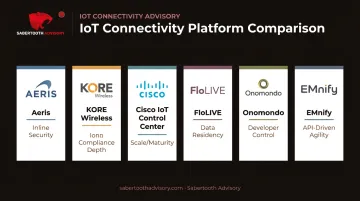
Top IoT Connectivity Platforms for 2026
The six platforms below were selected on five criteria:
- Global carrier reach
- SIM/eSIM lifecycle management
- Security depth
- Scalability
- Ease of integration
Each serves a different kind of buyer, so "best" depends heavily on your specific deployment profile.
Aeris
Aeris runs IoT Accelerator, a full-stack, cloud-native cellular connectivity platform built on its own telco-grade core network. It serves automotive, energy, healthcare, and retail clients that need carrier-grade reliability at scale.
IoT Watchtower sets it apart: a security layer embedded directly in the live network data path. It sees application traffic, destinations, and protocols within active sessions, and can block malicious domains or trigger SIM throttling automatically. Aeris also supports agentless deployment across 190+ countries through multi-operator eSIM orchestration.
| Criterion | Details |
|---|---|
| Best For | Enterprises needing carrier-grade security and predictable global pricing |
| Key Strength | Multi-operator eSIM orchestration plus inline security enforcement |
| Consideration | Enterprise-focused positioning; smaller deployments may find it more robust than required |
KORE Wireless
KORE is a global IoT MVNO that bundles connectivity with lifecycle services through its KORE One and ConnectivityPro platforms. Per KORE's 2024 SEC filing, the company managed 19.7 million connections at the end of 2024, up from 18.5 million the year before.
KORE's differentiators are breadth and compliance depth: FDA facility registration, ISO 9001/13485 certification, and HIPAA alignment make it a common choice for connected health and logistics fleets that need documentation trails as much as bandwidth.
| Criterion | Details |
|---|---|
| Best For | Businesses wanting bundled connectivity plus device logistics and provisioning services |
| Key Strength | Broad multi-carrier reach and managed-services ecosystem |
| Consideration | Usage-based pricing can be complex; security leans toward monitoring rather than inline blocking |
Cisco IoT Control Center
Formerly Jasper (acquired by Cisco in 2016), IoT Control Center is one of the most established CMPs in the industry. Cisco's own materials cite 300 million-plus connected devices, over 50 communications service providers, and 32,000 businesses running on the platform.
Its strengths are operational maturity: zero-touch provisioning, granular SIM-level diagnostics, and a real-time rating and billing engine that supports prepaid, pooled, and location-based billing models out of the box.
| Criterion | Details |
|---|---|
| Best For | Carrier-grade cellular connectivity management at global scale |
| Key Strength | Automated provisioning with proven large-scale enterprise adoption |
| Consideration | Security model is largely policy-based/reactive; carrier-dependent architecture can limit flexibility |
FloLIVE
FloLIVE runs a cloud-native, distributed core network with local breakout points in dozens of markets, serving MVNOs, enterprises, and mobile operators directly. Its multi-IMSI SIMs switch networks based on policy, compliance, and coverage rules, and the platform supports eSIM, eUICC, and SGP.32 remote provisioning.
The white-label, multi-tenant architecture makes FloLIVE a common pick for organizations that need to brand their own connectivity experience or keep data traffic local for compliance reasons.
| Criterion | Details |
|---|---|
| Best For | Enterprises needing local network profiles and data-residency compliance |
| Key Strength | Distributed core network with roaming-free local breakout model |
| Consideration | Contract-based pricing; connectivity-centric focus means added tooling may be needed for deep analytics |
Onomondo
Onomondo takes a developer-first approach, giving technical teams direct access to network and signaling data most CMPs abstract away. Its Network Marketplace spans 680+ networks in 180+ countries, and switching carriers is handled through policy rather than a lengthy renegotiation process.
Pricing is pay-as-you-go for active SIMs and data used, and no-code Cloud Connectors push data straight into AWS IoT, Azure IoT, or similar endpoints over HTTPS, TLS, or MQTTS.
| Criterion | Details |
|---|---|
| Best For | Developer teams wanting granular network insight and flexible carrier switching |
| Key Strength | Network Marketplace enabling real-time carrier switching plus traffic/signaling logs |
| Consideration | Smaller brand footprint than legacy telecom-backed providers; best suited to self-serve technical teams |
EMnify
EMnify built its own cloud-native mobile core rather than reselling carrier infrastructure, which lets it automate SIM management through a single REST API, including provisioning workflows and diagnostics.
Pricing runs on a pay-per-use model with tiers based on SIM count, making it a strong fit for pilots and seasonal deployments.
| Criterion | Details |
|---|---|
| Best For | Mid-market product teams wanting fast, API-driven SIM management |
| Key Strength | Software-defined core enabling rapid multi-carrier failover |
| Consideration | Global carrier footprint is smaller than legacy telecom-backed platforms |
How We Chose the Best IoT Connectivity Platforms
This list came from cross-referencing vendor documentation, analyst frameworks, and public filings against the priorities that actually matter to SMB and mid-market buyers — not just brand size or headline data rates.
Gartner's Critical Capabilities framework for managed IoT connectivity services evaluates providers on network coverage, portal features, security, analytics, and deployment services. We used a similar lens, weighted toward the factors growing businesses tend to underestimate.
The most common mistake we see: teams pick a platform based on top-line coverage numbers or name recognition, then get surprised by:
- Renewal terms that lock in pricing escalators
- Security that only monitors traffic instead of blocking threats
- Integration work that takes months longer than expected
- Billing complexity that makes cost forecasting difficult
Those pain points shaped how we scored each platform. Criteria stayed tied to business outcomes:
- Global coverage and eSIM flexibility
- Security and compliance certifications
- Integration and API depth
- Billing transparency
- Vendor lock-in risk at renewal
Conclusion
There's no single "best" IoT connectivity platform for every business. The right choice depends on your device volume, deployment geography, compliance obligations, and how much internal technical capacity you have to manage integrations.
As 5G RedCap and eSIM standards like SGP.32 continue to mature through 2026, benchmark your current platform's performance, contract terms, and scalability well before your renewal date arrives, not after.
Sabertooth Advisory runs vendor-neutral benchmarking across its 300+ supplier ecosystem to help SMB and mid-market teams compare IoT connectivity platforms and negotiate stronger terms, at no cost to you. If your renewal is on the horizon, start that conversation before you sign anything.
Frequently Asked Questions
What is an IoT connectivity platform?
An IoT connectivity platform is the software and network layer that provisions SIMs and eSIMs, manages multi-carrier connections, and tracks usage and billing for cellular IoT devices. It sits separately from device management and application layers.
How much does an IoT connectivity platform cost?
Total cost includes connectivity fees, platform fees, roaming charges, overages, and integration or support labor, not just the advertised per-SIM data rate. Hidden costs like SIM swaps and troubleshooting time add up over a contract's life.
What's the difference between an IoT connectivity platform and an IoT device management platform?
Connectivity platforms manage network and SIM operations: provisioning, carrier switching, billing. Device management platforms handle firmware updates, application data, and the physical device lifecycle in the field.
How do I choose the right IoT connectivity platform for my business?
Start with your device volume, target geographies, compliance requirements, and existing integration needs. These four factors narrow the field faster than comparing feature lists side by side.
Is eSIM better than traditional IoT SIM cards?
eSIM offers more flexibility for remote carrier switching and multi-market deployments without physical SIM swaps. Traditional SIMs can still work fine for simpler, single-region use cases where switching isn't a priority.
Can I switch IoT connectivity providers without disrupting existing deployments?
Migration is possible with proper eSIM or multi-IMSI planning and a phased rollout, but RCR Wireless notes that on-the-fly switching still isn't widely supported. Contracts, SLAs, and platform review are still required.