
Introduction
Most telecom contracts run 24 to 36 months, yet the average business negotiates one maybe once every few years. Meanwhile, the carrier's sales team does this every single day.
That mismatch shows up in the fine print: minimum revenue commitments buried on page 12, auto-renewal clauses that silently lock you into another term, and service level agreements too vague to enforce. Add limited internal expertise for benchmarking offers against current market rates, and businesses routinely sign deals stacked against them.
This guide breaks down what matters most before you sign your next telecom contract.
You'll learn how to prepare before sitting down at the table, which clauses carry the biggest financial impact, and how to build real negotiating power. We'll also cover the costliest mistakes businesses make and when bringing in independent expertise pays off.
Key Takeaways
- Preparation drives stronger negotiating outcomes than persuasion tactics
- Contract length, SLAs, MARCs, and auto-renewal terms carry outsized financial risk
- Credible competing bids create real leverage that friendly requests can't match
- Vendor-neutral advisors surface supplier options most businesses never see on their own
Prepare Before You Negotiate
Walking into a telecom renewal without preparation puts you at an immediate disadvantage. The provider's rep negotiates dozens of these deals a year. Your team negotiates one every couple of years, if that.
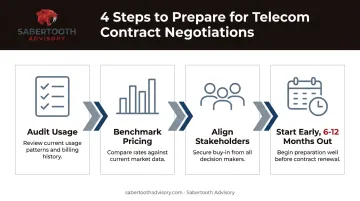
Audit What You're Actually Using
Before any conversation with a provider starts, pull together a full inventory:
- Active lines, circuits, and locations currently billed
- Data and bandwidth usage against what's provisioned
- Features and add-ons nobody remembers requesting
- Sites that closed, moved, or consolidated since the last renewal
Unused capacity and orphaned services are common findings in these audits, and every one of them is a bargaining chip once you can point to it in writing. Once that list is in hand, the next step is checking whether you're actually paying market rate for what's left.
Benchmark Against the Market
Telecom pricing doesn't move as one block. According to Bureau of Labor Statistics producer price data covering the past year:
- Business wired telecom pricing fell 1.4% year over year
- Wireless telecom pricing fell 3.2%
- Bundled wired access rose 7.6% over the same period
The takeaway: benchmark each service category separately. What's true for your mobile lines may not hold for your dedicated internet circuit.
Align Stakeholders Early
IT, finance, procurement, and the business units affected by service quality all need a seat at the table before terms get discussed. Without that alignment, a "great deal" on price can quietly ignore a bandwidth requirement operations flagged six months ago.
Many SMBs and mid-market companies don't have a dedicated procurement team to run this coordination in-house. That's often where an independent advisory firm like Sabertooth Advisory gets involved, pulling technical, financial, and operational requirements into one negotiating position before talks with the provider begin.
Start Early. Then Start Earlier.
Begin this process 6 to 12 months before contract expiration. Leverage erodes fast once you're inside the auto-renewal window, and providers know it.
Key Contract Terms and Clauses to Negotiate
These are the clauses with the biggest long-term impact on cost and flexibility, and the ones businesses most often accept without pushing back.
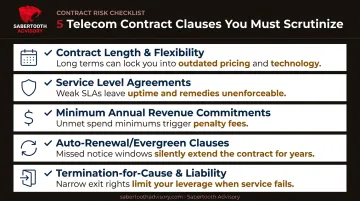
Contract Length and Flexibility
Cap terms at 24 to 36 months. Technology and pricing shift quickly, and a longer commitment can lock you into rates or equipment that are outdated before the contract even hits its midpoint. Ask for mid-term re-rate rights if a longer term is unavoidable.
Service Level Agreements (SLAs)
A usable SLA defines three things :
- Uptime commitment - stated as a specific percentage, not "industry standard"
- Response and repair times - how fast a ticket gets addressed, and by when service must be restored
- Credits for missed performance - the exact formula, not a vague promise of "compensation"
Vague SLA language gives the provider room to define its own accountability. Push for specifics before signing, not after an outage.
Minimum Annual Revenue Commitments (MARCs)
A MARC requires you to spend a minimum dollar amount with the provider each contract year, in exchange for better pricing. Providers push for high MARCs because it locks in predictable revenue on their side.
AT&T's own MARC notice documentation shows how this plays out. If your qualifying billed revenue falls short of the commitment, you owe the annual shortfall, meaning the difference between what you committed to and what you actually spent.
Before agreeing to any MARC, model out site closures, line reductions, or acquisitions that could change your spend. Then negotiate the commitment down, or push to eliminate it entirely.
Auto-Renewal and Evergreen Clauses
Evergreen clauses roll you into a brand new term automatically if you miss the cancellation window. Some providers apply a price increase, in one documented case a 10% bump, if you opt out late and move to month-to-month instead.
Request month-to-month rollover language as the default post-term state. It protects you without forcing an immediate renegotiation.
Termination-for-Cause and Liability Provisions
A termination-for-cause clause lets you exit if service quality genuinely fails, not just if you're unhappy. Pair it with liability and indemnity language that protects your business too, not only the provider's. Many standard contracts are written one-sided by default; this is a fixable imbalance.
Catching these imbalances before signing is where supplier-side experience pays off. Sabertooth Advisory's negotiation team, for instance, pulls benchmarks from its network of 300+ suppliers to flag one-sided terms before a contract is signed.
Use Leverage and Timing to Your Advantage
Real negotiating power comes from having actual competing bids in hand. Telling a provider you're "shopping around" rarely moves the needle.
Run a Structured RFP
Soliciting quotes from multiple providers, structured through a formal RFP, creates genuine price competition and gives you comparable data across offers. Without a standardized process, you're comparing apples to oranges every time.
Widen Your Supplier Pool
A structured RFP only works if you have real alternatives to compare. Most businesses default to the same two or three national carriers out of habit, which is a narrow field. Sabertooth Advisory's ecosystem of 300+ vetted technology suppliers gives clients access to competitive options and benchmarks most companies never see on their own.
Negotiate With Data
With competing offers in hand, build your case around collaboration:
- Bring usage trends that support your requested changes
- Bring competitor pricing that justifies a lower rate
- Frame requests as reasonable, evidence-backed asks
Harvard's principled negotiation framework recommends separating the people from the problem and grounding requests in objective criteria.
Know Your Walk-Away Point
Decide in advance what terms you won't accept, and be prepared to act on it. Providers make real concessions when they believe you have a viable alternative. If they sense you're bluffing, the leverage disappears.
Common Negotiation Mistakes to Avoid
Even well-prepared teams stumble on the same handful of issues.
- Signing the first redraft: providers expect multiple rounds of redlines. Accepting the first version leaves money and protections on the table.
- Overlooking ancillary fees: installation charges, training costs, and surcharges are often buried and rarely itemized, but they're frequently negotiable if you ask.
- Missing renewal deadlines: without calendar reminders tied to specific notice windows, businesses end up locked into unfavorable terms simply by running out the clock.
None of these are complicated to avoid, but they require someone tracking the details. That's exactly the gap Sabertooth Advisory's procurement advisors close for clients without dedicated purchasing teams.
When to Bring in an Independent Telecom Advisor
Negotiating well requires ongoing market intelligence: current pricing, supplier playbooks, and a sense of where providers have room to move. Most internal teams, especially those without a dedicated procurement function, don't have the bandwidth to maintain that.
A vendor-neutral advisor closes that gap. Sabertooth Advisory operates as a technology advocate, not a telecom agent or reseller, which means there's no incentive to steer you toward a specific carrier. The firm brings:
- Competitive benchmarks pulled from 300+ vetted suppliers
- Known supplier playbooks built from prior negotiations
- Line-by-line contract review covering pricing, SLAs, term length, and exit rights
- Advisory services delivered at $0 cost to the client, funded through the supplier ecosystem instead

This approach matters most for multi-site businesses, franchise operators, and PE-backed companies managing multiple contracts and supplier relationships across locations.
Tracking renewal dates alone across a dozen sites is a full-time job. Doing that while negotiating each contract from a position of strength is where independent expertise pays for itself.
Frequently Asked Questions
How to bid for telecom contracts?
Define your requirements clearly, then solicit quotes from multiple qualified providers through a structured RFP. Compare bids on price, SLAs, and contract terms side by side rather than in isolation.
Can you haggle phone contracts?
Yes. Most telecom pricing and terms, aside from taxes and regulatory fees, are negotiable, especially when you have competitive quotes in hand from other providers.
What is the 70/30 rule in negotiation?
It's a practitioner heuristic suggesting you listen roughly 70% of the time and talk 30%. In telecom talks, this helps surface where a provider actually has flexibility to move.
What are the five C's of negotiation?
The five C's are Clarity, Communication, Compromise, Creativity, and Commitment. In telecom talks, this means clear requirements, active dialogue, and compromise on non-critical terms.
When is the best time to negotiate a telecom contract renewal?
Start 6 to 12 months before your contract expires. Leverage decreases sharply as the renewal or auto-renewal date approaches, leaving less room to negotiate.
What is a MARC and why does it matter in telecom negotiations?
A MARC (Minimum Annual Revenue Commitment) is a minimum annual spend you commit to in exchange for pricing discounts. Aim to reduce or eliminate MARCs, since falling short triggers shortfall charges on the unmet amount.