Introduction
Data center capacity is getting harder to secure. AI workloads, cloud repatriation, and colocation demand are straining supply everywhere.
Primary-market data center supply grew 34% year-over-year to 6,922.6 MW in H2 2024, while vacancy dropped to a record-low 1.9%, according to CBRE's North America Data Center Trends report. Demand isn't slowing down either.
For SMB and mid-market teams without dedicated procurement staff, this tightening market creates a real problem. Vague RFPs. Missed technical requirements. Surprise costs at renewal time.
This guide breaks down what a data center RFP is, which types you might need, and the components that separate a strong RFP from a weak one.
It also covers the mistakes that derail most first-time efforts—and how independent advisory support changes the outcome.
Key Takeaways
- A well-structured RFP reduces downtime risk, hidden costs, and vendor lock-in
- Include business requirements, technical specs, security, SLAs, and pricing so vendors compete on equal terms
- Match RFP type to purpose—colocation, relocation, design/build, or managed services—to avoid scope gaps
- Independent, vendor-neutral advisory shortens timelines and strengthens negotiating leverage
What Is a Data Center RFP and Why It Matters
A data center RFP (Request for Proposal) is a formal document businesses issue to solicit competitive, comparable proposals from colocation, hosting, or facility providers. It's a different animal from an RFI (Request for Information), which simply gathers general vendor capabilities without soliciting a formal bid.
What Triggers a Data Center RFP
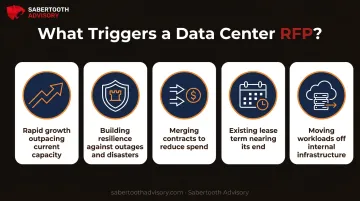
Most organizations don't wake up one day and decide to run an RFP for fun. There's usually a business event forcing the issue:
- Expansion driven by new markets or added capacity
- Disaster recovery planning requiring a secondary site
- Cost consolidation across multiple existing vendors
- Lease expiration at a current colocation facility
- Shift away from in-house infrastructure toward outsourced capacity
The Cost of Getting It Wrong
A poorly scoped RFP produces inconsistent vendor responses that can't be fairly compared side by side. That alone creates decision paralysis. But the bigger risk shows up later, after the contract is signed.
Downtime is expensive. One hour of downtime exceeded $300,000 for more than 90% of mid-size and large enterprises surveyed, and 41% put the cost at $1 million to $5 million or more, per ITIC's 2024 Hourly Cost of Downtime Report. Those figures don't even include litigation or regulatory penalties.
A structured RFP creates a defensible, apples-to-apples comparison framework. It gives decision-makers a clear record when leadership asks why a vendor was chosen, and it shields the business from the operational fallout of a mismatched provider.
Here's the catch: RFPs are typically managed by IT, facilities, or procurement teams. Organizations without dedicated staff often can't allocate the months of work a proper RFP demands, so the process gets rushed or skipped entirely.
Types of Data Center RFPs You Might Need
Not every data center RFP looks the same. The right structure depends entirely on what you're trying to accomplish.
- Colocation/Hosting RFP — Renting rack space, power, and cooling in a shared facility. Prioritize available space, connectivity options, and the provider's financial and operational stability.
- Relocation RFP — Moving existing infrastructure to a new site. You'll need logistics planning, chain-of-custody for equipment in transit, and cutover scheduling that keeps downtime low.
- Design & Build/Engineering RFP — Constructing or retrofitting a facility. Cover the Basis of Design, applicable standards compliance, and the commissioning process before go-live.
- Managed Services/Cloud Transition RFP — Hybrid or fully outsourced infrastructure management. Emphasize SLA structures, support tier definitions, and whether the provider can scale with your growth.
Mixing these up is one of the fastest ways to end up with irrelevant vendor responses. A colocation provider isn't going to give you a meaningful answer to a design/build question, and vice versa.
Core Components Every Data Center RFP Should Include
This is the section that determines whether your RFP actually works. Get this checklist right, and vendor responses become directly comparable. Get it wrong, and you're stuck comparing apples to refrigerators.
Business Requirements & Scope of Work
Start by documenting your current and projected needs:
- Rack space requirements, power draw, and a 3-5 year growth timeline
- Project milestones and a realistic decision-making schedule
- Required deliverables and evaluation weighting (cost vs. reliability vs. location) defined upfront
Skipping this step is why so many RFPs collapse into subjective scoring arguments later.
Facility, Technical & Redundancy Specifications
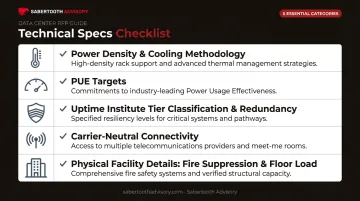
This is where technical alignment happens. Request specifics on:
- Power density (kW per rack) and cooling methodology
- PUE targets for each facility under consideration
- Uptime Institute Tier classification (I through IV) or N+1/2N redundancy expectations
- Carrier-neutral connectivity and cross-connect availability
- Physical facility details: fire suppression standards, environmental controls, floor load capacity
For context, the weighted-average PUE across facilities was 1.54 in 2025, per the Uptime Institute's 2025 Global Data Center Survey, with newer facilities averaging 1.48. Carrier neutrality matters too: it keeps you from locking into a single network provider later.
N+1 or 2N component counts don't automatically establish a Tier rating on their own. Distribution pathways and topology matter just as much as component redundancy, so don't assume a vendor's "2N" claim means what you think it means without asking follow-up questions.
Security, Compliance & Certifications
Compliance requirements vary significantly by industry, and your RFP needs to reflect that explicitly rather than treating compliance as an afterthought.
- Documented alignment with relevant frameworks: HIPAA, PCI-DSS, SOC 2 Type II, or CMMC, based on your vertical
- Evidence of physical security protocols: biometric access, 24/7 monitoring, visitor logging
- Third-party audit reports validating those claims
A healthcare organization's compliance checklist will look nothing like a manufacturer's. Scope it to your actual regulatory exposure, not a generic template.
SLAs, Personnel & Support Terms
Uptime commitments only matter if they're backed by real accountability.
- Minimum uptime SLA percentage, with defined financial credits for non-performance
- On-site staffing levels, remote hands availability, and escalation response times
- Reporting cadence: quarterly reviews, real-time dashboards, or both
Staffing shortages are a real industry issue right now. 46% of data center operators report difficulty filling roles, according to the same Uptime Institute survey. Ask vendors directly how they're staffing your account, not just their facility in general.
Pricing, Contract Terms & Exit Clauses
This is where hidden costs tend to surface.
- Require an itemized cost breakdown: setup, recurring, power overage, and cross-connect fees
- Clarify contract length, auto-renewal clauses, and early termination penalties
- Get explicit language on decommissioning and data destruction responsibilities at contract end
Vague pricing sections are how "competitive" quotes turn into expensive surprises 18 months in.
Common Mistakes That Derail Data Center RFPs
Even well-intentioned teams stumble on the same issues repeatedly:
- Vague or generic requirements that yield vendor responses you cannot compare fairly, so decisions fall back on gut feel
- Underestimating time and resources, which stretches multi-vendor timelines by months when no one owns the process
- Skipping compliance, redundancy, and scalability upfront, then facing costly re-negotiations or full migrations when the gap surfaces
Unclear requirements are where most of the damage starts. Uptime Institute's construction review found that 88% of data center projects experienced issues during construction, and 22% were serious enough to affect capacity or redundancy outcomes. Most of those problems traced back to unclear requirements at the outset, not vendor incompetence.
Why Work With an Independent Advisor for Your Data Center RFP
Most publicly available data center RFP templates come from a single provider or reseller. That means the questions are structured to favor their own offering, whether or not that's the best fit for your workload.
An independent advisor changes that dynamic. Sabertooth Advisory runs the RFP process on your behalf, drawing on an ecosystem of 300+ vetted technology suppliers to generate genuine competitive bidding rather than a single vendor's terms.
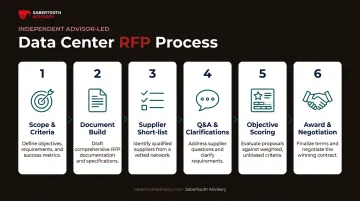
Here's how that plays out across six stages:
- Scope & Criteria: defining requirements, evaluation criteria, and weighting with your stakeholders
- Document Build: writing the full RFP, including scoring rubric and commercial template
- Supplier Short-list: inviting a credible short-list from the supplier ecosystem
- Q&A & Clarifications: running vendor demos, reference calls, and Q&A sessions
- Objective Scoring: scoring every response against the same rubric across capability, commercial terms, and risk
- Award & Negotiation: selecting the winning vendor and negotiating final contract terms
This structure gives internal teams the rigor of a formal process without losing months of staff time to coordination and vendor chasing.
Sabertooth's advisory model runs on $0 advisory fees to clients. Compensation comes from the supplier ecosystem, not from you. That removes cost as a barrier to getting expert guidance on a decision that will affect infrastructure spend for years.
Regulated industries get an extra layer of protection. Sabertooth's advisory practices align with SOC 2 Type II, HIPAA, PCI-DSS, and CMMC, so you can evaluate colocation partners against the same obligations your environment must meet.
Frequently Asked Questions
What should be included in a data center RFP?
A complete RFP covers business requirements, facility and technical specifications, security and compliance certifications, SLA terms, and a full pricing breakdown. Missing any one of these categories makes vendor responses harder to compare fairly.
What's the difference between an RFP and an RFI for data centers?
An RFI gathers general information about a vendor's capabilities without requesting a formal bid. An RFP solicits a defined, comparable proposal against specific requirements, terms, and evaluation criteria for an actual project.
How long does the data center RFP process typically take?
Timelines vary based on project complexity, but most processes span several weeks to a few months from initial drafting through vendor selection. Facility tours, technical validation, and compliance review all add time.
What Uptime Institute Tier level should I request in my RFP?
Match tier level to your real uptime and redundancy needs—not a default label. Most enterprises specify Tier III for concurrent maintainability; Tier IV adds full fault tolerance through independent, physically isolated systems.
How many vendors should I invite to bid on a data center RFP?
A shortlist of 3-5 qualified vendors typically balances competitive pricing against manageable evaluation effort. Inviting too many creates comparison fatigue without meaningfully improving your options.
Do I need a consultant to manage my data center RFP process?
Not required. An independent advisor can accelerate the timeline, keep vendor comparisons unbiased, and cut internal workload—especially for teams without dedicated procurement staff.