This isn't a minor IT decision. It shapes your cost structure (CapEx vs. OpEx), how fast you can scale, and whether you stay compliant as regulations tighten.
This guide breaks down the real differences between colocation and hyperscale, where each one fits, and how an independent, vendor-neutral advisor can help SMB and mid-market teams compare both paths without bias baked into the recommendation.
Key Takeaways
- Colocation fits SMB and mid-market growth with shared, multi-tenant space and flexible leasing.
- Hyperscale campuses target cloud giants and extreme AI workloads at massive single-tenant scale.
- Scale, ownership, contract length, and cost structure separate the models more than any single feature.
- Multi-site and PE-backed organizations often blend colocation with hyperscale-adjacent cloud access.
- Independent benchmarking prevents long-term lock-in before you sign anything.
Colocation vs. Hyperscale: Quick Comparison
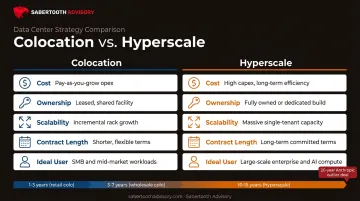
The two models solve different problems at different scales. Here's how they stack up on the factors that drive a buying decision:
| Factor | Colocation | Hyperscale |
|---|---|---|
| Cost | Lower upfront investment; predictable monthly OpEx | High build-out cost; economical only at extreme power draw |
| Ownership | Third-party owned, multi-tenant (retail or wholesale) | Often owned or leased directly by the hyperscaler |
| Scalability | Incremental, limited by facility capacity | Near-unlimited, standardized across thousands of servers |
| Contract length | Typically 1-3 years retail, 3-7 years wholesale | Often 10-15 years, sometimes longer for major AI leases |
| Ideal user | SMB, mid-market, multi-site, franchise organizations | Large enterprises, cloud providers, AI-scale operators |
Contract length is where the gap widens most. Retail colocation deals run 1-3 years, wholesale suites stretch to 3-7 years, and hyperscale commitments typically run 10-15 years.
Some AI infrastructure deals now push past that. A recent Anthropic lease locked in a 20-year, $19 billion term — still the exception, not the rule.
That contract math alone explains why most growing businesses lean colocation. Locking into a 15-year commitment makes sense for a cloud giant projecting demand a decade out. It rarely makes sense for a 200-employee logistics company.
What Is Colocation?
Colocation means renting rack, cage, or suite space in a third-party facility instead of building your own data center. You bring the servers; the provider handles power, cooling, physical security, and connectivity.
For SMB and mid-market firms that have outgrown a server closet but don't want hyperscale-level capital spending, colocation fills that gap. The operational payoff shows up in three places:
- Lower capital burden: no facility to build, no generators to maintain
- Built-in redundancy and security: power backup, fire suppression, and access controls come standard
- Interconnection access: cross-connects to carriers, cloud platforms, and partners inside the same building
Retail vs. Wholesale Colocation
Not all colocation looks the same. Retail colocation sells space by the rack or fractional rack, bundles shared amenities, and typically runs shorter contracts (1-3 years).
Wholesale colocation provides a dedicated, customizable suite with longer leases (3-7 years, sometimes longer for build-to-suit deals) and more control over power density and layout.
Most growing companies start retail and graduate to wholesale as their footprint expands.
Use Cases of Colocation
Colocation fits organizations that need secure, professionally managed infrastructure without hiring dedicated data center staff:
- Multi-site businesses and franchise operators standardizing infrastructure across locations
- PE-backed portfolios consolidating fragmented IT environments after acquisition
- Healthcare organizations needing HIPAA-compliant hosting for patient data systems
- Retail companies running POS and e-commerce infrastructure with cloud on-ramps built in
Those use cases are showing up in the market data. The global colocation market was valued at $84.05 billion in 2024 and is projected to reach $204.41 billion by 2030, growing at a 14.4% CAGR according to MarketsandMarkets. Colocation has moved from specialty infrastructure into a mainstream IT choice.
What Is a Hyperscale Data Center?
Hyperscale facilities sit at the other end of the spectrum. These are massive, purpose-built campuses (typically 10,000+ square feet and 5,000+ servers) designed for extreme-scale cloud, AI, and big-data workloads.
The operational logic differs from colocation:
- Standardized infrastructure replicated across sites for repeatable efficiency
- Energy optimization achieved only at massive scale
- Purpose-built support for AI training clusters and inference workloads that would overwhelm a standard facility
Not every hyperscale-grade deployment involves a facility owned outright by the hyperscaler. Some space gets leased through wholesale providers as dedicated floors or buildings within larger colocation campuses. JLL notes that hyperscalers use both self-building and leasing strategies, so ownership structures vary.
Use Cases of Hyperscale
Hyperscale infrastructure fits a narrow but massive-volume segment:
- Cloud service providers running global infrastructure at continental scale
- AI-driven companies training large language models requiring thousands of GPUs
- Global enterprises running large-scale analytics across distributed data sets
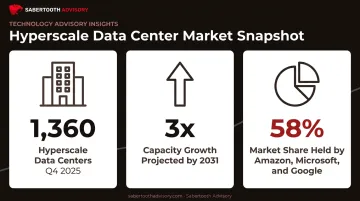
The growth curve is steep. Synergy Research counted 1,360 large hyperscale data centers operated by major companies as of Q4 2025, and projects hyperscale capacity to more than triple through 2031. Amazon, Microsoft, and Google alone control roughly 58% of that capacity. That concentration keeps deepening as AI demand accelerates.
Colocation vs. Hyperscale: Which Is Right for Your Business?
This decision comes down to five questions, not one:
- Budget model — Do you want predictable OpEx, or can you absorb massive CapEx for guaranteed scale?
- Workload type — Is your usage steady-state, or does it spike with AI training or seasonal bursts?
- Growth trajectory — Are you scaling incrementally, or projecting exponential compute demand?
- Compliance requirements — Does your industry (healthcare, finance, retail) demand specific certifications?
- Control over design — Do you need to dictate power density and layout, or is standardized infrastructure fine?
Choose Colocation If...
You prioritize cost-efficiency, flexibility, and multi-site connectivity. This is the common fit for most SMB and mid-market organizations — you get enterprise-grade physical security and redundancy without the capital outlay or the decade-long lease.
Choose Hyperscale (or Hyperscale-Adjacent Access) If...
Your workloads demand extreme, dedicated scale — think large AI training clusters or global cloud operations serving millions of users. Few mid-market companies land here directly. Many still reach hyperscale capacity through cloud platforms hosted inside colocation facilities.
The Hybrid Reality
Plenty of multi-site and franchise businesses run core operations in colocation while tapping cloud or hyperscale access for burst capacity and AI workloads. For most companies, the right answer is a blend calibrated to what each workload needs.
Sabertooth Advisory evaluates a client's workload profile — power needs, compliance obligations, latency sensitivity, growth timeline — against a 300+ supplier ecosystem spanning colocation providers and cloud platforms.
There's no incentive to push a hyperscaler over a colocation facility, or vice versa. The recommendation follows the workload, not a preferred-vendor list.
Real-World Example: Choosing the Right Data Center Strategy
Software company 37signals, which runs Basecamp and Hey, published a clear example of this trade-off.
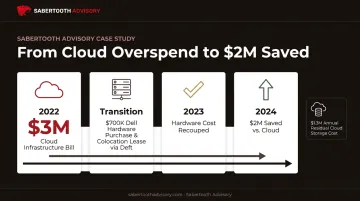
The trigger: In 2022, the company spent more than $3 million on cloud infrastructure. That bill became the catalyst for a hard look at whether cloud was the right long-term home for their workloads.
The move: Rather than building a facility, 37signals bought roughly $700,000 worth of Dell hardware and leased rack space, bandwidth, power, and support through colocation provider Deft, at facilities including Digital Realty and Equinix.
The outcome: According to Data Center Dynamics reporting on the company's 2024 results, 37signals recouped its hardware cost during 2023 and estimated $2 million saved in 2024 compared to staying on cloud infrastructure.
The transition wasn't total. The company still carried roughly $1.3 million in annual cloud storage costs for data awaiting migration. These decisions rarely resolve as a clean, single-model switch.
The takeaway: A rising cloud bill doesn't automatically mean "build a data center." Model the multi-year cost of cloud, colocation, and hybrid options side by side before you commit. Vendor-neutral benchmarking and structured RFP support help teams avoid overpaying for unused cloud elasticity or locking into colocation contracts sized for the wrong workload.
Conclusion
There's no universal winner between colocation and hyperscale. The right choice depends on your workload scale, budget structure, growth stage, and compliance obligations. For many organizations, the smartest path blends both.
What matters most is tying the decision to outcomes you can measure: cost control, uptime, compliance posture, and how fast you can scale when demand shifts. Before signing a multi-year contract either way, an independent advisor like Sabertooth Advisory can structure an apples-to-apples comparison that a single vendor's sales team never will.
Frequently Asked Questions
What is the difference between colocation and hyperscale data centers?
Colocation is shared facility space leased on flexible terms to multiple tenants. Hyperscale is massive, purpose-built infrastructure (typically 10,000+ sq. ft. and thousands of servers) designed for a single operator's extreme-scale workloads.
Who are the Big 5 hyperscalers?
The major hyperscale operators are Amazon (AWS), Microsoft (Azure), Google Cloud, Meta, and Alibaba. Amazon, Microsoft, and Google alone account for roughly 58% of global hyperscale capacity.
Is colocation cheaper than hyperscale?
Colocation generally requires lower upfront investment and offers more flexible terms. Hyperscale infrastructure becomes cost-efficient only at extreme scale, and it usually requires a 10-15 year commitment to make financial sense.
What is the difference between retail and wholesale colocation?
Retail colocation offers smaller, shared-amenity space with shorter contracts (1-3 years), typically sold by the rack. Wholesale colocation provides larger, dedicated, customizable suites with longer terms (3-7 years or more).
Can a small or mid-sized business access hyperscale-level infrastructure?
Yes, indirectly. SMBs typically reach hyperscale capabilities through cloud services or through colocation facilities that host direct network on-ramps to AWS, Azure, and Google Cloud, not by leasing hyperscale space outright.
How do I choose the right data center strategy for my business?
Start by assessing your workload needs, budget model, and compliance requirements. Independent, vendor-neutral guidance, like an evaluation from Sabertooth Advisory, helps you compare colocation and cloud options before you sign anything.