That's a problem. Cloud contracts are drafted by the provider, for the provider. Auto-renewal clauses, liability caps, and vague data ownership language can quietly lock a growing business into terms nobody negotiated. Techaisle reported in 2023 that 90% of US SMBs were actively expanding their cloud usage, which means more organizations are exposed to these contracts than ever before.
This guide breaks down what a cloud computing contract actually is, the four types of cloud services it typically covers, the clauses worth fighting over, and how to negotiate one from a position of strength.
Key Takeaways
- A cloud contract legally governs service delivery, access rights, and provider obligations
- IaaS, PaaS, SaaS, and serverless models each carry distinct contractual risks
- SLAs, data protection, payment terms, and auto-renewal clauses deserve the closest scrutiny
- Independent review before signing prevents costly surprises at renewal or termination
What Is a Cloud Computing Contract?
A cloud computing contract is a legally binding agreement between a cloud service provider (CSP) and a business. It spells out how data gets stored, how applications run, and how software gets accessed online.
It defines who's responsible for what: uptime, security, support, pricing, and what happens if either side fails to deliver.
This differs meaningfully from a traditional software license. A license grants rights to install and run a copy of software on your own systems, one time. A cloud contract governs an ongoing hosted relationship instead.
The American Bar Association notes that cloud services generally provide remote access to software running on the provider's infrastructure, rather than transferring a copy for local installation. That shift moves responsibility for uptime, security, and continuity onto the provider, for better or worse.
You'll see these agreements called a few different things:
- Cloud services agreement
- Cloud computing agreement
- SaaS agreement
- Master subscription agreement
The name matters less than the substance: what the contract actually covers matters more than what it's titled.
Who's Involved: The Three Parties in a Cloud Contract
Most cloud arrangements involve three distinct actors, though they're rarely bound by a single unified contract:
- Cloud Service Provider (CSP): Handles infrastructure, uptime, and baseline security, following a published shared responsibility model. Think AWS, Microsoft Azure, or Google Cloud.
- Client/Customer: Owns data privacy compliance, user access management, and identity verification. Providers won't stop an employee from using a weak password.
- Third-party vendors: Marketplace publishers or integration partners supporting the CSP, usually under separate terms. Read those add-on terms independently.
The 4 Types of Cloud Services Covered in a Contract
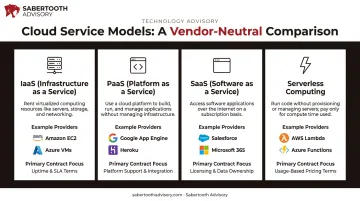
The type of cloud service you're buying determines what terms, responsibilities, and pricing structures show up in the contract. A storage-only IaaS deal looks nothing like a SaaS subscription on paper.
Infrastructure as a Service (IaaS)
IaaS gives you on-demand access to computing power, storage, and virtualization, such as Amazon EC2 or Azure Virtual Machines. Because you're managing the operating system and applications yourself, these contracts emphasize scalability commitments and disaster recovery terms. You own more of the stack, so you carry more of the risk.
Platform as a Service (PaaS)
PaaS provides a managed environment where developers build and deploy applications without worrying about underlying servers. Google App Engine and Heroku fall into this category. Contracts here focus heavily on development environment SLAs, since downtime doesn't just affect end users: it stalls your entire build pipeline.
Software as a Service (SaaS)
SaaS delivers ready-to-use hosted applications like Salesforce or Microsoft 365. These contracts emphasize user licensing tiers, data ownership language, and subscription terms. This is where most SMBs spend the bulk of their cloud budget, and where auto-renewal clauses cause the most headaches.
Serverless Computing
Serverless computing (AWS Lambda, Azure Functions) automates infrastructure management entirely, billing you only for actual usage. Contracts focus on pay-per-use pricing structures and event-driven service limits, meaning a traffic spike can translate directly into a cost spike if limits aren't clearly defined.
Key Components Every Cloud Computing Contract Should Include
A well-drafted cloud contract covers six core areas. Missing any one of these leaves your business exposed.
- Service Level Agreement (SLA): Defines uptime guarantees, response times, and remedies like service credits. AWS commits to 99.99% for region-level deployments but only 99.5% for a single EC2 instance, so your architecture determines the promise you actually get.
- Data protection and security: Covers encryption standards, data residency, and compliance obligations like HIPAA, PCI-DSS, or GDPR. Healthcare needs a signed Business Associate Agreement; retailers need clear PCI-DSS scope language.
- Payment terms and hidden costs: Beyond the subscription fee, watch for data transfer charges, backup storage fees, and API call overages. These line items rarely appear in the sales pitch.
- Term, renewal, and auto-renewal clauses: Spells out the initial contract length and how renewal windows work. Unnoticed auto-renewals remain one of the most common (and costliest) contract pitfalls.
- Liability, indemnification, and termination: Caps on provider liability, indemnification for data breaches, and what happens to your data (portability and reversibility) once the contract ends.
- Governing law and dispute resolution: Determines which jurisdiction's courts hear a dispute. This matters a great deal for multi-location or cross-border businesses.
Common Risks and Costly Contract Pitfalls to Avoid
Most CSP contracts are drafted to protect the provider first. Signing without review means accepting the provider's assumptions about liability, data handling, and cost escalation.
The most common pitfalls include:
- Vendor lock-in and poor data portability: Vague exit and data-retrieval terms make switching providers later slow and expensive, leaving you with little negotiating leverage.
- Uncontrolled cost overruns: Flexera's 2025 survey found that 84% of organizations call managing cloud spend a top challenge, with budgets exceeding limits by an average of 17%.
- Steep renewal price hikes: Enterprise SaaS renewal pricing often climbs 10-20% or more, a trend widely reported by industry analysts that catches unprepared businesses off guard.
Catching these terms before signing is exactly where an independent advisor earns its value. Sabertooth Advisory's contract negotiation team flags vendor-favorable clauses like these before they become locked-in liabilities.
Cost concerns don't end at renewal. Not every business pays from day one: many providers offer free tiers or trial credits. But most business-grade cloud services carry subscription and usage-based fees that escalate sharply once those limits are exceeded or renewal terms kick in.
How to Negotiate a Cloud Computing Contract That Protects Your Business
Negotiating leverage starts before you ever talk to a provider.
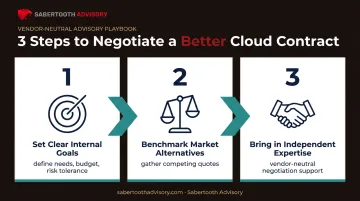
- Set clear internal goals first: define the functionality you actually need, your budget ceiling, and your risk tolerance. Negotiations stay focused on business outcomes instead of drifting toward whatever the provider is pushing that quarter.
- Benchmark against real market alternatives: businesses that negotiate without comparing competing offers routinely accept above-market terms. Even informal quotes from two or three providers change the conversation.
- Bring in independent, vendor-neutral expertise: this is where most SMBs fall short — they simply don't have a dedicated procurement team to lean on.
Sabertooth Advisory's Contract Negotiation and Procurement Advisory services give businesses access to supplier benchmarks and negotiation experience across 300+ vetted technology providers, at no advisory cost to the client. That means contracts get negotiated from a position of strength rather than signed as-is.
The ongoing Procurement Advisory retainer also tracks renewal dates and auto-renewal windows six to twelve months out, so cloud contracts never quietly roll over on the provider's terms.
For regulated industries, this matters even more:
- Healthcare clients need BAAs, audit rights, and defined breach notification windows built into cloud agreements.
- Retail and franchise operators need PCI-DSS scope addressed explicitly, not assumed.
A vendor-neutral advisor who already understands these frameworks catches gaps before they become liabilities.
Frequently Asked Questions
What is a cloud contract?
A cloud contract is a legally binding agreement between a business and a cloud provider that outlines service terms, responsibilities, and pricing. It governs an ongoing hosted relationship rather than a one-time software purchase.
Do I have to pay for cloud services?
Many providers offer free tiers or trial credits for smaller workloads. However, most business-grade cloud services require subscription or usage-based payment, so reviewing pricing clauses closely matters before you scale up.
What are the 4 types of cloud services?
IaaS provides raw computing infrastructure, PaaS offers a managed development environment, SaaS delivers ready-to-use applications, and serverless computing automates infrastructure with pay-per-use billing. Each carries different contract priorities.
What is the difference between a cloud contract and a service level agreement (SLA)?
The SLA is typically a component within, or attached to, the broader cloud contract. It focuses specifically on performance guarantees like uptime, response times, and credit remedies.
What happens to my data if I cancel a cloud contract?
Well-drafted contracts specify data portability and reversibility terms, including the format data will be returned in, the timeframe, and any retrieval costs involved. Poorly drafted ones leave this dangerously vague.
Who should review a cloud computing contract before signing?
Legal counsel should review the contract alongside an independent technology advisor, such as Sabertooth Advisory, who can benchmark terms against market standards. That combination catches both legal exposure and unfavorable business terms.